flowchart TB

BIO["Many tissues<br/>Many processes<br/>Many delays"]

ABS["Compartment abstraction"]

CENT["Central compartment"]

PERI["Peripheral compartment"]

BIO --> ABS
ABS --> CENT
CENT <--> PERI
What is a Compartment?
Understand what a compartment represents, why it is useful, and how to think about it correctly in pharmacometrics.
Tip
What you’ll build today: a correct mental model of compartments as useful abstractions rather than physical reality.
Learning Objectives
By the end of this lesson, you will be able to:
- Define a compartment in pharmacometric terms
- Explain why compartments are used
- Distinguish abstraction vs biology
- Understand how compartments connect to observed data
Key Ideas
A compartment is not a physical organ.
It is a mathematical simplification that helps describe how drug concentration changes over time.
Instead of modeling every tissue and biological process, we group behavior into:
- a small number of compartments
- with simplified movement between them
Insight: Compartments are chosen because they work, not because they are anatomically correct.
Warning
It is a common misconception that compartments correspond directly to organs (e.g., “central = blood”, “peripheral = tissue”).
This is not generally true.
Why Do We Use Compartments?
Real biological systems are:
- complex
- heterogeneous
- not directly observable
Compartment models allow us to:
- summarize behavior with a few parameters
- fit models to data
- make predictions
Think of compartments as:
A way to compress reality into something usable
From Biology to Compartments
A compartment model compresses a complex biological system into a simpler representation.
The goal is not to reproduce anatomy.
The goal is to capture the observed behavior using a simpler structure.
Worked Example: One-Compartment Thinking
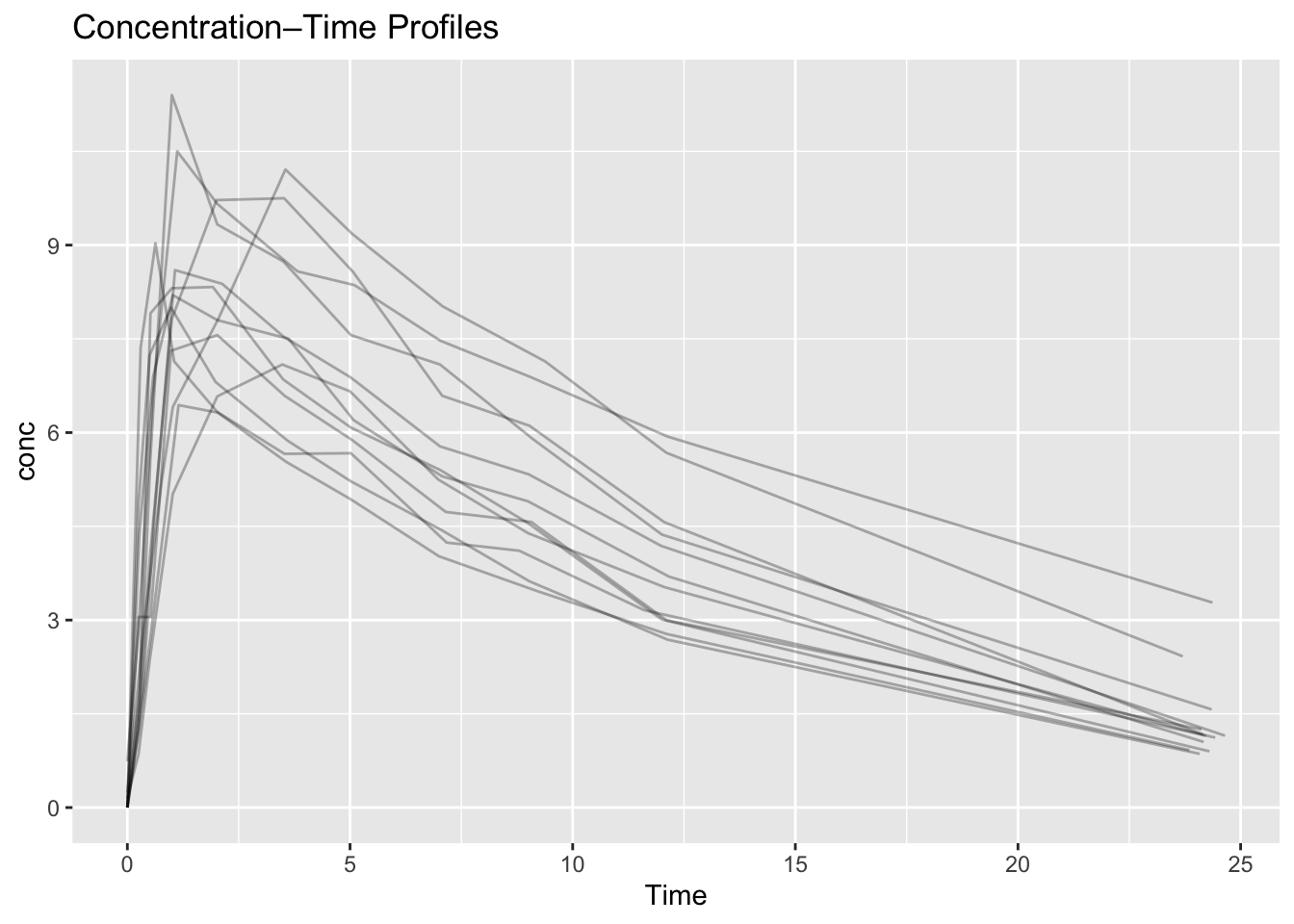
A one-compartment model assumes:
- drug distributes instantly
- concentration is uniform throughout the system
- decline is driven by elimination
This is clearly a simplification.
But:
👉 it often describes observed data surprisingly well
Expanding the Example
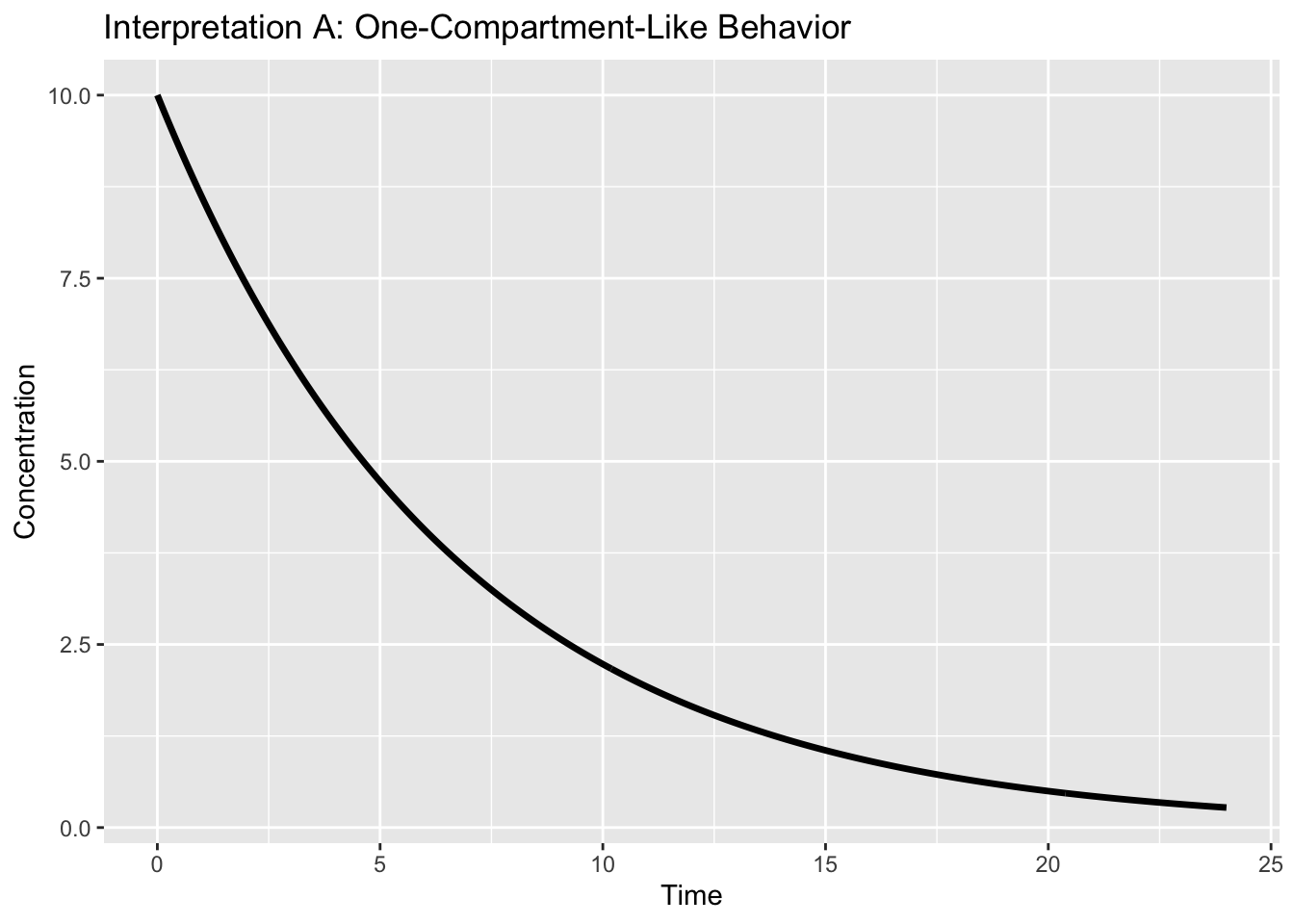
Imagine two different stories for the same observed profile.
Interpretation A: One Simple Behavioral Space
Interpretation B: More Complex Biology
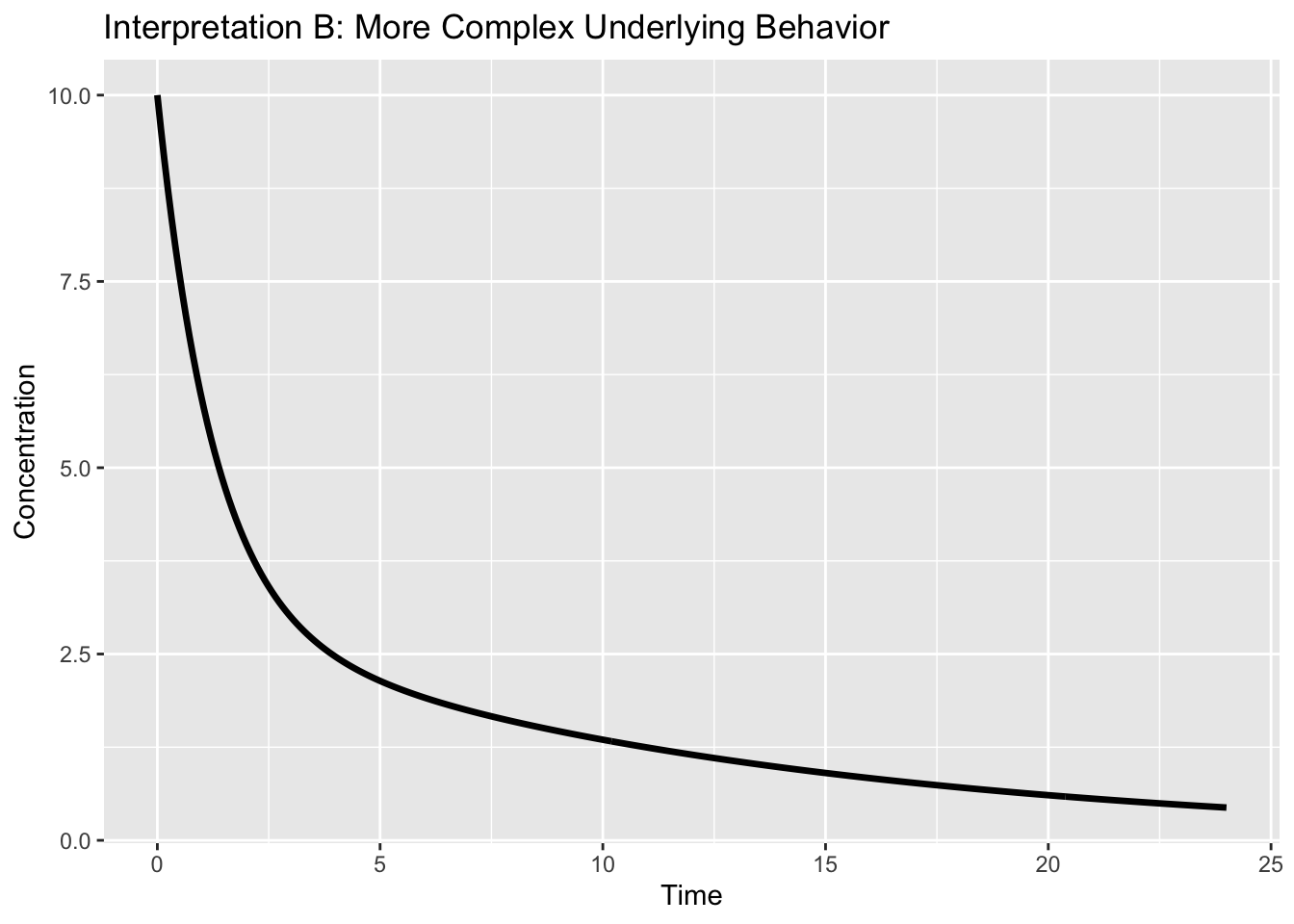
These profiles may not look dramatically different at first glance.
But one could arise from a simple abstraction while the other reflects richer underlying behavior.
The important idea is:
compartments describe observed behavior — they are not photographs of biology.
Insight
A compartment should be interpreted as:
- a behavioral unit, not a physical one
- a way of summarizing how concentration changes
Note
A useful question is:
“What kind of simplification is needed to explain this data?”
Strategies
- Start with the simplest model that explains the data
- Add complexity only when justified by clear evidence
- Focus on what the model explains, not what it represents physically
- Use models as tools for reasoning, not literal descriptions
Common Mistakes
- Treating compartments as physical organs
- Assuming model structure reflects true biology
- Adding compartments just to improve fit
- Over-interpreting parameters from poorly supported models
Practice Problems
- What is a compartment in pharmacometrics?
- Why are compartments used instead of modeling full biology?
- Why can different compartment models explain the same data?
TipStep-by-Step Solutions
- A mathematical simplification representing drug behavior
- Because real systems are too complex to model directly
- Because models describe observed behavior, not unique biological truth
Summary
Compartments are:
- abstractions
- simplifications
- tools for understanding and prediction
They are valuable because they allow us to:
- explain data
- estimate parameters
- make decisions
But they must always be interpreted carefully.
A model can still be useful even if it is not biologically complete.
TipQuick Tips
- Compartments are not anatomy
- Simplicity is intentional
- Fit does not imply truth
- Multiple models can explain the same data
- Always ask: “What does this model represent, not what is it?”