Simulation and Scenario Thinking
Understand how pharmacometric models are used to simulate scenarios and support decision-making under uncertainty.
Tip
What you’ll build today: the ability to think in terms of simulation—using models to explore “what-if” scenarios and predict outcomes before they happen.
Learning Objectives
By the end of this lesson, you will be able to:
- Explain the role of simulation in pharmacometrics
- Understand scenario-based thinking
- Connect simulation to uncertainty and variability
- Interpret simulation outputs for decision-making
Key Ideas
Once a model is built and evaluated, it can be used to answer:
What happens if we change something?
This is the role of simulation.
Simulation allows us to:
- predict outcomes under new conditions
- explore dosing strategies
- quantify uncertainty
Why This Lesson Matters
Clinical decisions often need to be made before data exist.
Examples:
- What dose should we test next?
- What happens if we dose twice daily instead of once?
- How will a new population respond?
Simulation provides a way to answer these questions.
From Data to Prediction
Previously:
- Data → Model → Evaluation
Now:
- Model → Simulation → Decision
Insight: Simulation turns models into decision tools.
Warning
Simulation results are only as reliable as the model behind them.
The Simulation Workflow
Simulation starts with a question.
A typical workflow is:
Question
↓
Model
↓
Simulate scenarios
↓
Summarize outcomes
↓
Make decisions
Examples:
- Which dose achieves target exposure?
- Which schedule minimizes toxicity?
- Which population needs adjustment?
Simulation is useful because decisions can be evaluated before collecting new data.
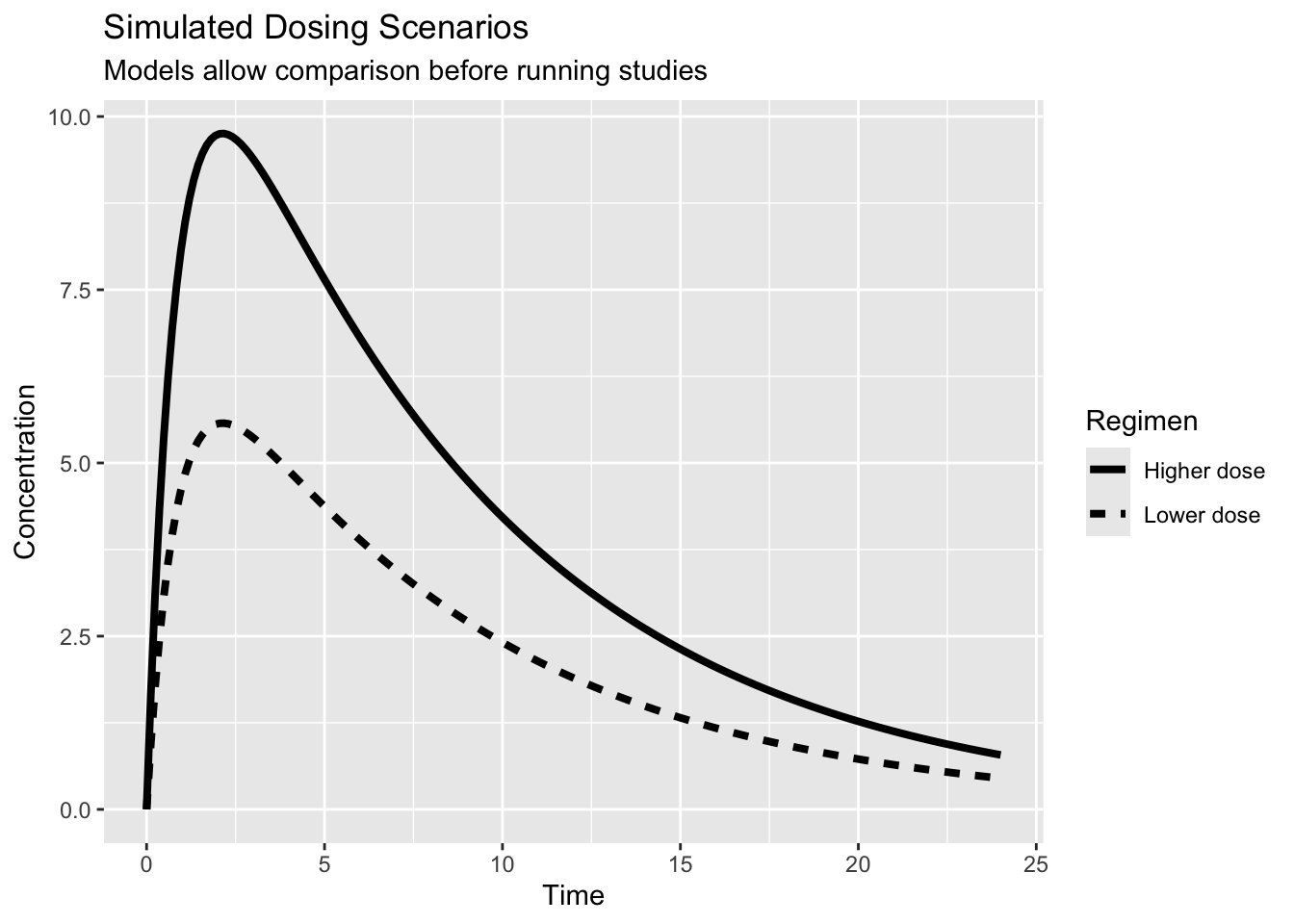
Worked Example: Dosing Scenarios
This simulation compares:
- two dose levels
- resulting exposure profiles
Simulation allows us to evaluate options before generating new data.
Expanding the Example
Different simulations answer different questions.
Dose scenarios:
→ Which dose reaches target exposure?
Schedule scenarios:
→ Once daily vs twice daily?
Population scenarios:
→ Does response change in children or older adults?
Adherence scenarios:
→ What happens when doses are missed?
The model stays the same.
Only the question changes.
Insight
Simulation is not about predicting the future—it is about exploring possible futures.
Note
Good simulation studies focus on decision-relevant scenarios, not just interesting ones.
Variability and Uncertainty
Simulation incorporates:
- inter-individual variability
- parameter uncertainty
- residual variability
This allows us to ask:
- What is the range of possible outcomes?
- What fraction of patients achieve target exposure?
This allows us to ask:
- What is the range of possible outcomes?
- What fraction of patients achieve target exposure?
A simulation result is usually not:
one predicted outcome
It is:
a distribution of possible outcomes
Why This Matters for Decisions
Simulation supports:
- dose selection
- trial design
- risk assessment
Example:
- Choose dose that achieves target exposure in 80% of patients
Strategies
- Define clear decision questions
- Simulate realistic scenarios
- Incorporate variability
- Interpret results probabilistically
Common Mistakes
- Treating simulation as prediction certainty
- Ignoring model limitations
- Simulating irrelevant scenarios
- Overinterpreting results
Practice Problems
- What is the purpose of simulation?
- Why is variability important in simulation?
- What makes a good simulation study?
TipStep-by-Step Solutions
- To explore outcomes under different scenarios
- Because patients differ and outcomes vary
- Clear question, realistic scenarios, and proper interpretation
Summary
Simulation:
- uses models to explore scenarios
- incorporates variability and uncertainty
- supports decision-making
It transforms models into practical tools.
TipQuick Tips
- Simulation = structured “what-if” analysis
- Always include variability
- Focus on decision-relevant scenarios
- Interpret results probabilistically
- Trust depends on model quality