Pharmacodynamics: From Exposure to Effect
Understand how exposure translates into biological effect and how pharmacodynamics extends pharmacometric thinking beyond PK and decision-focused exposure-response.
Tip
What you’ll build today: a clear understanding of how pharmacokinetics connects to pharmacodynamics—and how exposure translates into biological effect.
Learning Objectives
By the end of this lesson, you will be able to:
- Define pharmacodynamics (PD) in practical terms
- Distinguish decision-focused exposure–response from mechanistic PD thinking
- Understand common PD relationships (Emax, sigmoidal)
- Recognize how PD extends pharmacometric modeling
Key Ideas
In the previous module, you used exposure–response to support decisions:
- What exposure achieves efficacy?
- What exposure causes toxicity?
Now we shift perspective:
PD asks: how does biology respond to exposure?
This extends the chain:
- Dose → PK → Exposure → PD → Effect
Why This Lesson Matters
Exposure–response and pharmacodynamics are closely related.
Exposure–response often asks:
- What exposure achieves efficacy?
- What exposure causes toxicity?
Pharmacodynamics asks:
- How does effect change over time?
- Why does effect change?
- What biological processes may explain the response?
You can think of PD as extending exposure–response toward biological interpretation.
Warning
Exposure–response and PD are not competing ideas.
PD provides additional structure when understanding mechanism becomes important.
PK vs PD (Refined View)
PK
- Concentration over time
- Drug movement
PD
- Effect over time
- Biological response
Bridge
- Exposure connects the two
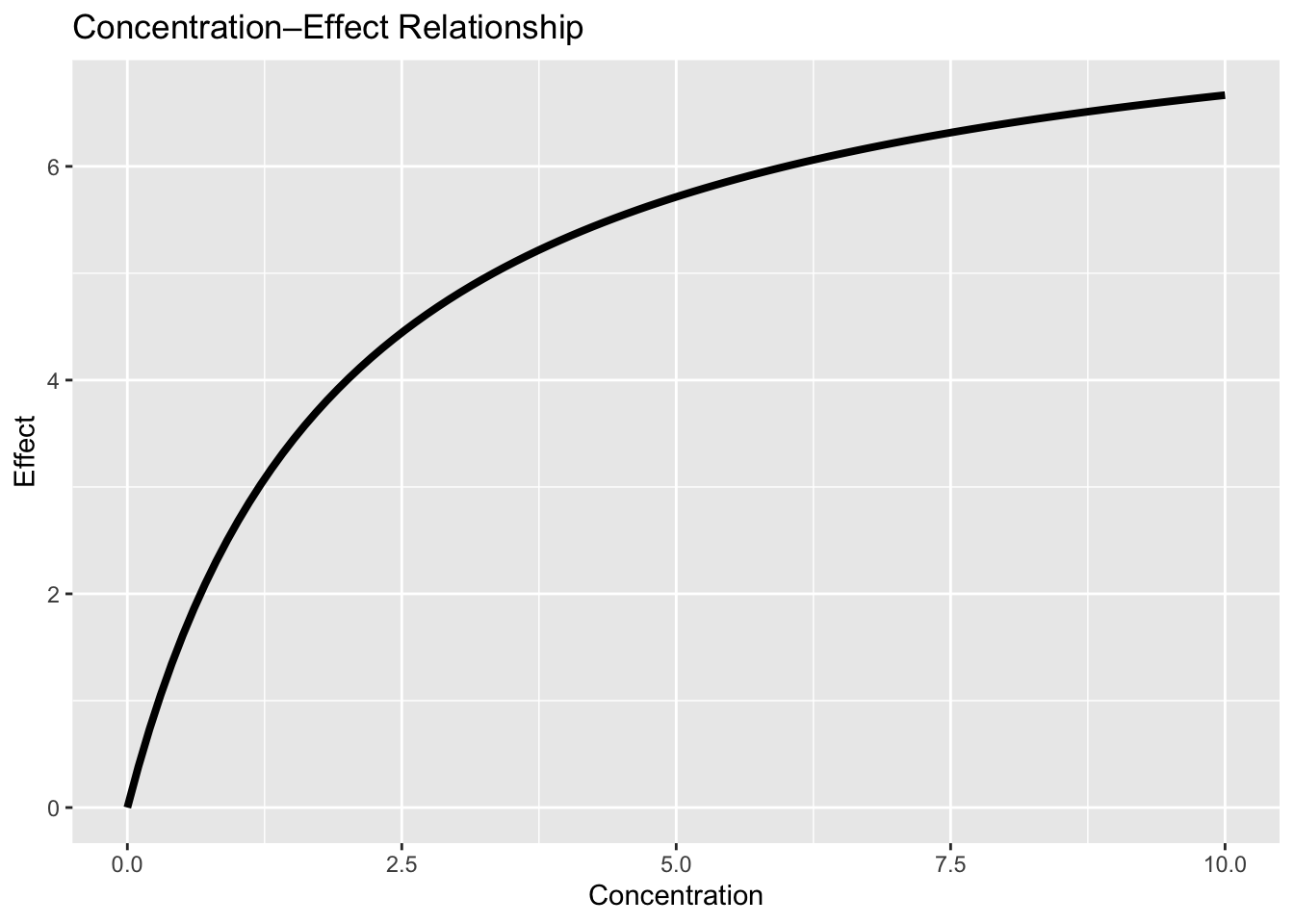
Worked Example: From Exposure to Effect
You can interpret:
- low concentration → little effect
- increasing concentration → larger effect
- plateau → saturation of response
Notice:
- doubling concentration does not always double effect
Common PD Models
Linear Model
- Simple proportional relationship
Emax Model
- Saturation occurs
\[ E = \frac{E_{max} \cdot C}{EC_{50} + C} \]
Sigmoidal Emax (Hill) Model
- gradual response at low exposure
- steeper change near the middle
- eventual saturation
One Important Difference from PK
PK often asks:
How much drug is present?
PD often asks:
What effect is occurring?
Those are not always synchronized.
Effect may:
- occur later than concentration
- persist after concentration decreases
- continue through downstream biology
This phenomenon is one reason pharmacodynamic modeling becomes important.
Insight
Biological systems are often nonlinear and saturable.
Note
This is why simple exposure–response relationships can break down at high exposure.
Expanding the Idea
Real PD behavior can include:
- delays between concentration and effect
- indirect responses (biomarker cascades)
- different relationships for efficacy vs toxicity
This is where full PD modeling becomes necessary.
Why This Matters for Decisions
PD allows you to define:
- therapeutic window
- exposure targets
- safety margins
But now with:
- biological interpretation
- mechanistic reasoning
Strategies
- Start with exposure–response
- Add PD structure when needed
- Consider nonlinear models
- Always connect to biology
Common Mistakes
- Treating exposure–response as mechanistic
- Ignoring PD variability
- Overcomplicating too early
- Misinterpreting plateau effects
Practice Problems
- How does PD differ from exposure–response thinking?
- What does Emax represent?
- Why do many PD relationships plateau?
TipStep-by-Step Solutions
- PD focuses on biological mechanisms, not just decision relationships
- Maximum achievable effect
- Because biological systems saturate
Summary
Pharmacodynamics:
- connects exposure to biological effect
- introduces mechanism into modeling
- explains nonlinear behavior
It builds on exposure–response and extends it into biology.
TipQuick Tips
- Exposure–response = decision tool
- PD = biological explanation
- Expect nonlinear behavior
- Saturation is common
- Use PD when mechanism matters