Dose, Exposure, and Sampling
Understand how dose, exposure, and sampling design shape what you can observe and interpret in PK data.
Tip
What you’ll build today: intuition for how dose enters the system, how exposure is observed, and how sampling design determines what the data can reveal.
Learning Objectives
By the end of this lesson, you will be able to:
- Explain the difference between dose and exposure.
- Describe how sampling design shapes what can be learned from PK data.
- Recognize why missing early or late samples can change interpretation.
- Understand why estimation depends on what parts of the profile are actually observed.
Key Ideas
Dose is the input.
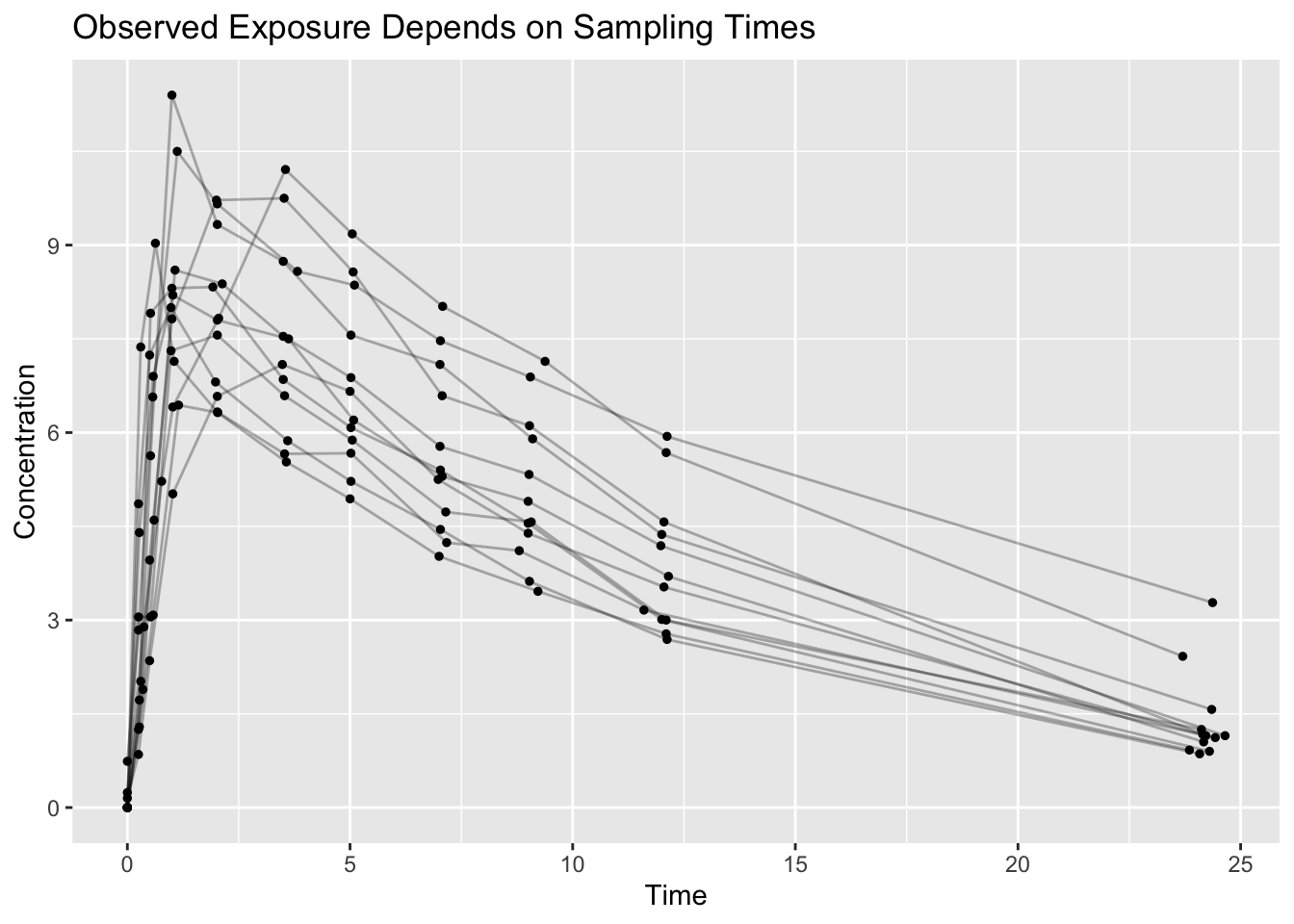
Exposure is the resulting concentration pattern over time.
But even if dose is known exactly, exposure is only partially visible through the sampling schedule.
That means interpretation depends on two things:
- what happened biologically
- what was actually measured
Insight: You can only estimate what your data allow you to see.
Warning
A missing part of the profile is not just an inconvenience.
It can remove the very information needed for a reliable interpretation.
Dose Is Not the Same as Exposure
A dose tells you how much drug entered the system.
It does not tell you automatically:
- how high concentrations will rise
- how quickly the peak will occur
- how long exposure will persist
- how much subjects will differ from one another
Those are questions about exposure, and exposure must be inferred from observed concentration–time data.
This is why two people can receive the same dose and still show different concentration profiles.
Worked Example: Seeing the Profile in Theoph
Now imagine modifying the design:
- remove most early samples
- remove most late samples
- keep only a few middle time points
The dose would be unchanged.
But the interpretation of exposure would change substantially.
Worked Example Expansion: Missing the Peak
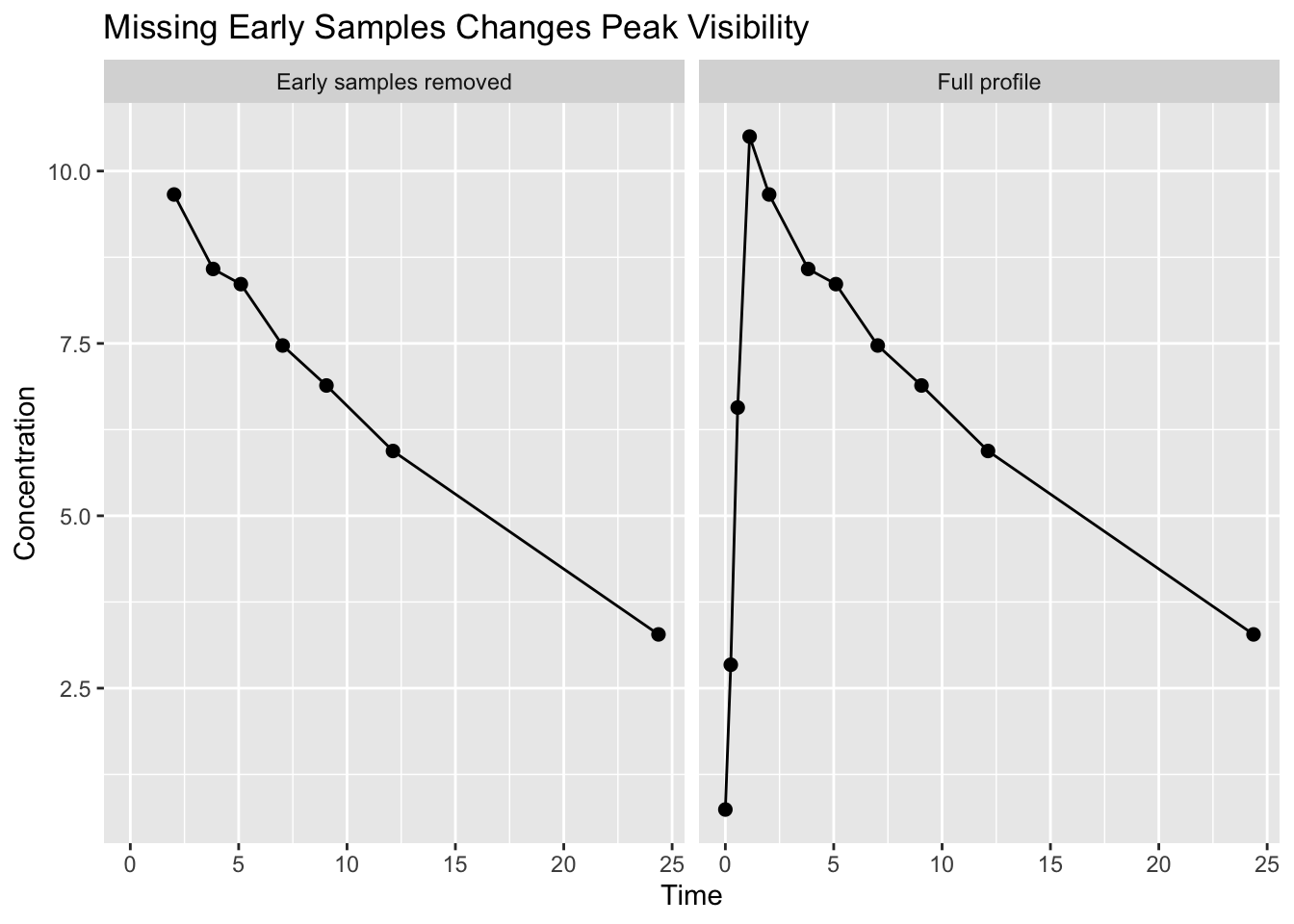
Suppose the study missed the early absorption phase.
The underlying biology has not changed.
Only the observations changed.
Questions:
- Did the dose change?
- Does observed peak concentration appear lower?
- Would estimating time to peak become harder?
Notice that missing the peak creates uncertainty about what happened immediately after dosing.
This is not a model problem.
It is a visibility problem.
Worked Example Expansion: Missing the Tail
Now imagine the opposite design.
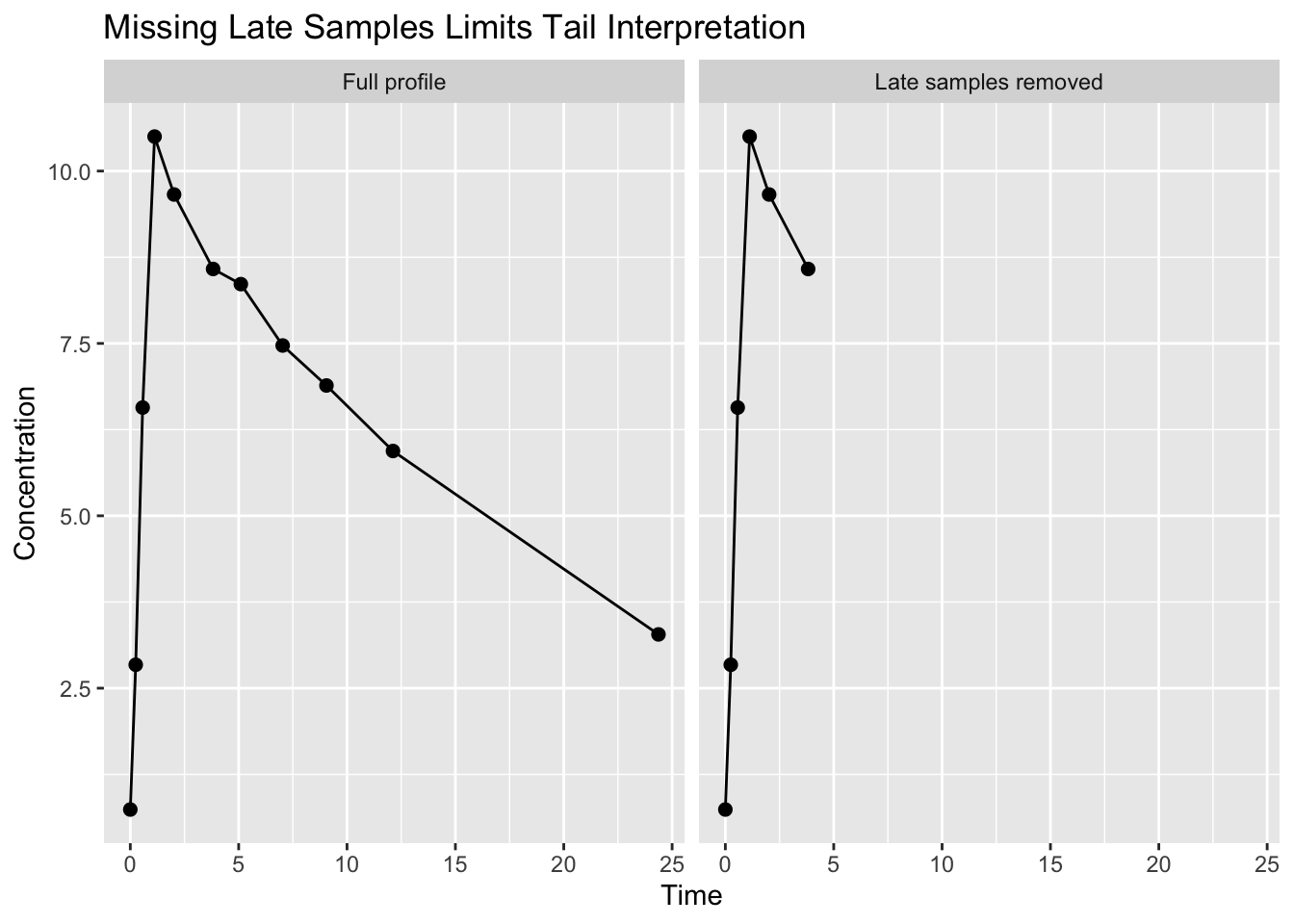
Early behavior is captured well, but late samples are removed.
Questions:
- Can you still see the general shape?
- Can you estimate how long exposure persists?
- Would elimination be easier or harder to understand?
Late samples often contribute disproportionately to understanding persistence and terminal decline.
Insight
Sampling design determines more than convenience.
It determines:
- what parts of the system are visible
- what metrics can be estimated reliably
- what model behavior can be checked
- what uncertainty is unavoidable
This is why good pharmacometric reasoning starts before modeling and often before data collection.
Note
A useful design question is: “What part of the profile do I need to observe in order to answer my scientific question?”
Strategies
- Match sampling times to the biological questions of interest
- Ensure the design covers early, middle, and late profile behavior when possible
- Interpret missing parts of the profile as missing information, not just missing points
- Ask whether the data support the parameter or conclusion being discussed
Common Mistakes
- Treating dose as if it were equivalent to exposure
- Ignoring how sampling limits interpretation
- Over-interpreting metrics that rely on unseen parts of the profile
- Assuming incomplete profiles can answer the same questions as complete ones
Practice Problems
- Why is dose not the same thing as exposure?
- What can happen if the peak is missed by the sampling schedule?
- Why can late sampling matter even when early behavior is well captured?
- What determines whether a profile supports a given interpretation?
TipStep-by-Step Solutions
- Dose is the amount administered, while exposure is the resulting concentration pattern over time.
- Peak concentration may be underestimated, and early absorption behavior may become unclear.
- Because late samples help reveal persistence, decline, and terminal-phase behavior.
- The combination of biological behavior and what the sampling design actually observed.
Summary
Dose starts the process, but exposure is what unfolds over time.
What you learn about exposure depends not only on biology, but also on sampling.
That means every PK dataset should be read with two linked questions in mind:
- What happened in the body?
- What portion of that process did the study actually allow us to observe?
TipQuick Tips
- Dose is input; exposure is outcome over time.
- Sampling design determines what is visible.
- Missing phases of the profile mean missing information.
- Good estimation depends on seeing the right parts of the curve.
- Ask what the design allows you to conclude before drawing conclusions.