flowchart TB

DATA["Observed concentration–time data"]

DATA --> M1["Model A<br/>One compartment"]

DATA --> M2["Model B<br/>Two compartments"]

M1 --> D["Similar decisions"]
M2 --> D
Limitations of Compartmental Models
Understand what compartment models can and cannot tell you, and why multiple models can explain the same data.
Tip
What you’ll build today: a realistic understanding of what models mean — and what they don’t mean.
Learning Objectives
By the end of this lesson, you will be able to:
- Explain why multiple models can fit the same data
- Understand the concept of model ambiguity
- Recognize limits of inference from PK data
- Interpret models as tools rather than truth
Key Ideas
Compartment models are not unique representations of reality.
It is possible for:
- multiple models
- with different structures
to fit the same data equally well.
Insight: A good fit does not guarantee a correct model.
Warning
A model that fits perfectly can still be wrong about the underlying system.
One Observation, Multiple Explanations
Observed data do not uniquely determine the underlying system.
Different structures may explain the same observations.
That does not mean the models are identical.
It means the data may not contain enough information to uniquely distinguish them.
Worked Example: Two Models, Similar Data
Suppose two different models are fit to the same observed concentrations.
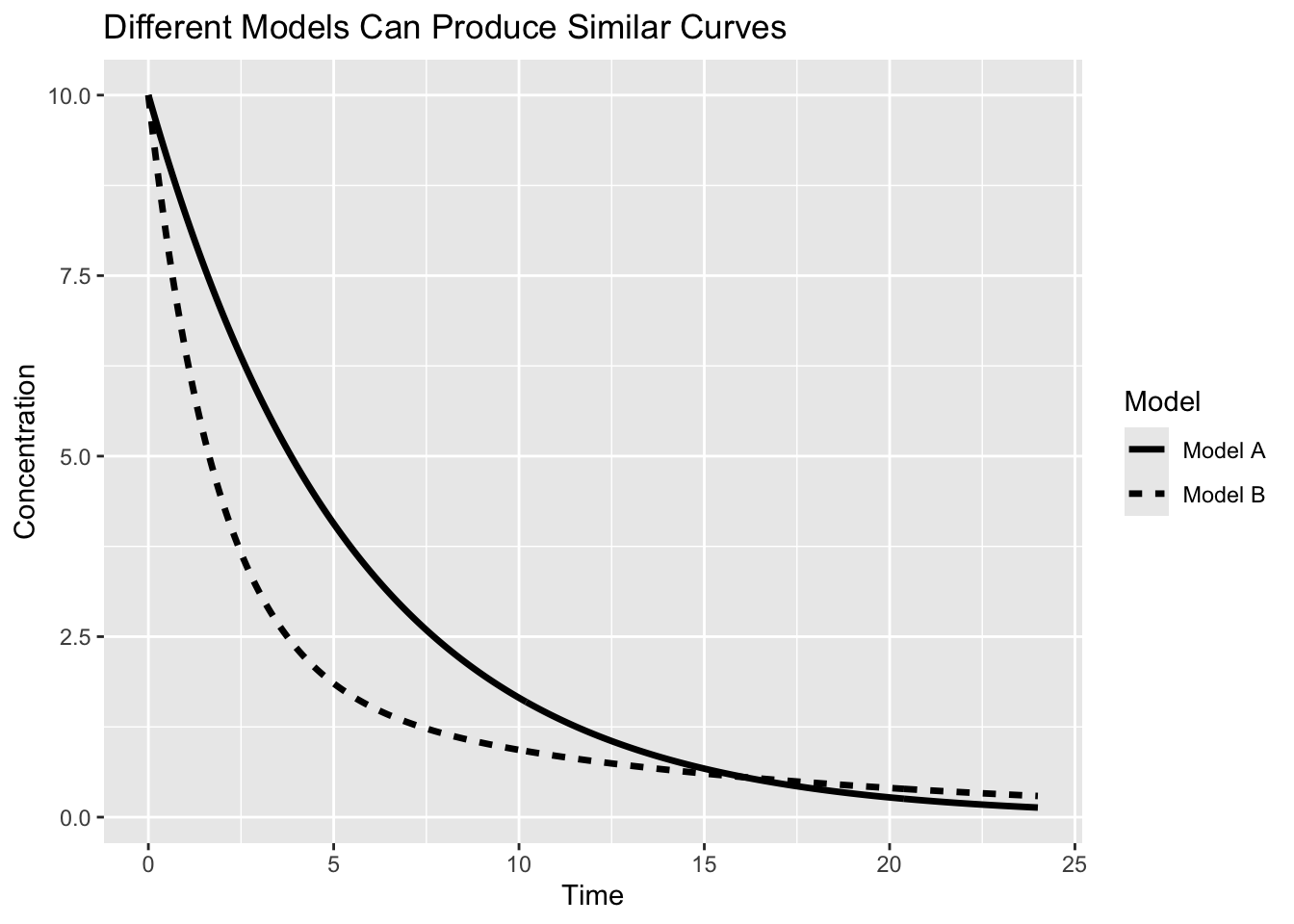
At first glance these curves may appear similar.
But they imply different explanations:
- Model A → simpler interpretation
- Model B → additional hidden behavior
Which is correct?
The observed data may not contain enough information to tell you.
Expanding the Example
Why does ambiguity happen?
Because we only observe a small part of the system.
flowchart LR

BIO["Underlying biology"]

BIO --> T["Hidden processes"]

T --> OBS["Observed concentrations"]

style T fill:#eeeeee
We observe concentrations.
We do not directly observe:
- tissue concentrations
- transport mechanisms
- internal gradients
- hidden states
Different internal explanations can generate similar observed profiles.
Insight
This leads to a fundamental idea in pharmacometrics:
Models describe data behavior, not necessarily biological truth
Note
A useful question is:
“What conclusions are supported by the data — regardless of model structure?”
What Can Models Do Well?
Models are excellent for:
- summarizing data
- estimating parameters
- interpolating within observed ranges
- simulating scenarios
What Models Cannot Guarantee
Models cannot guarantee:
- correct biological interpretation
- unique structure
- accurate extrapolation beyond data
- mechanistic truth
Strategies
- Focus on the question the model is answering
- Prefer simpler models when they explain the data
- Use external knowledge (biology, prior data)
- Evaluate whether conclusions are robust across models
Common Mistakes
- Assuming best fit = correct model
- Over-interpreting model structure
- Ignoring uncertainty in model selection
- Believing parameters reflect true physiology directly
Practice Problems
- Can two different models explain the same PK data?
- Why can’t model structure be uniquely determined from data alone?
- What should you focus on instead of “which model is true”?
TipStep-by-Step Solutions
- Yes, multiple models can fit the same data.
- Because we observe limited outputs, not the full system.
- Focus on what conclusions are supported and decisions being made.
Summary
Compartment models are:
- useful
- powerful
- but limited
They help us:
- describe data
- make predictions
But they do not guarantee:
- biological truth
- unique interpretation
A useful model is not necessarily the only possible model.
TipQuick Tips
- Fit ≠ truth
- Multiple models can explain the same data
- Focus on decisions, not structure
- Use models as tools, not answers
- Always question what is actually identifiable