flowchart LR

FIT["Does it fit?"]

-->

INTERP["Does it make sense?"]

-->

PRED["Does it predict?"]

-->

DEC["Can we trust decisions?"]
Why Model Evaluation Matters
Understand why pharmacometric models must be evaluated, what can go wrong, and how model assumptions impact decisions.
Tip
What you’ll build today: a clear understanding of why model evaluation is essential, what “good” and “bad” models look like, and how assumptions impact decisions.
Learning Objectives
By the end of this lesson, you will be able to:
- Explain why model evaluation is necessary
- Understand the role of assumptions in modeling
- Recognize what can go wrong even when models “fit”
- Connect model evaluation to decision-making
Key Ideas
A model is not useful just because it can be estimated.
It must be evaluated.
All models rely on assumptions:
- structural assumptions
- statistical assumptions
- data assumptions
If those assumptions are wrong:
- the model may still fit
- but the conclusions may be incorrect
Insight: A good fit does not guarantee a good model.
Warning
It is possible for a model to describe observed data well and still fail when used for prediction or decision-making.
Why This Lesson Matters
Up to this point, you’ve learned:
- how models are built
- how variability is represented
- how parameters are estimated
Now comes the critical question:
Can we trust the model?
This is where model evaluation comes in.
A Mental Model for Evaluation
Model evaluation asks progressively harder questions.
A model should move successfully through all stages.
Good fit alone is not enough.
Worked Example: Good Fit, Wrong Model
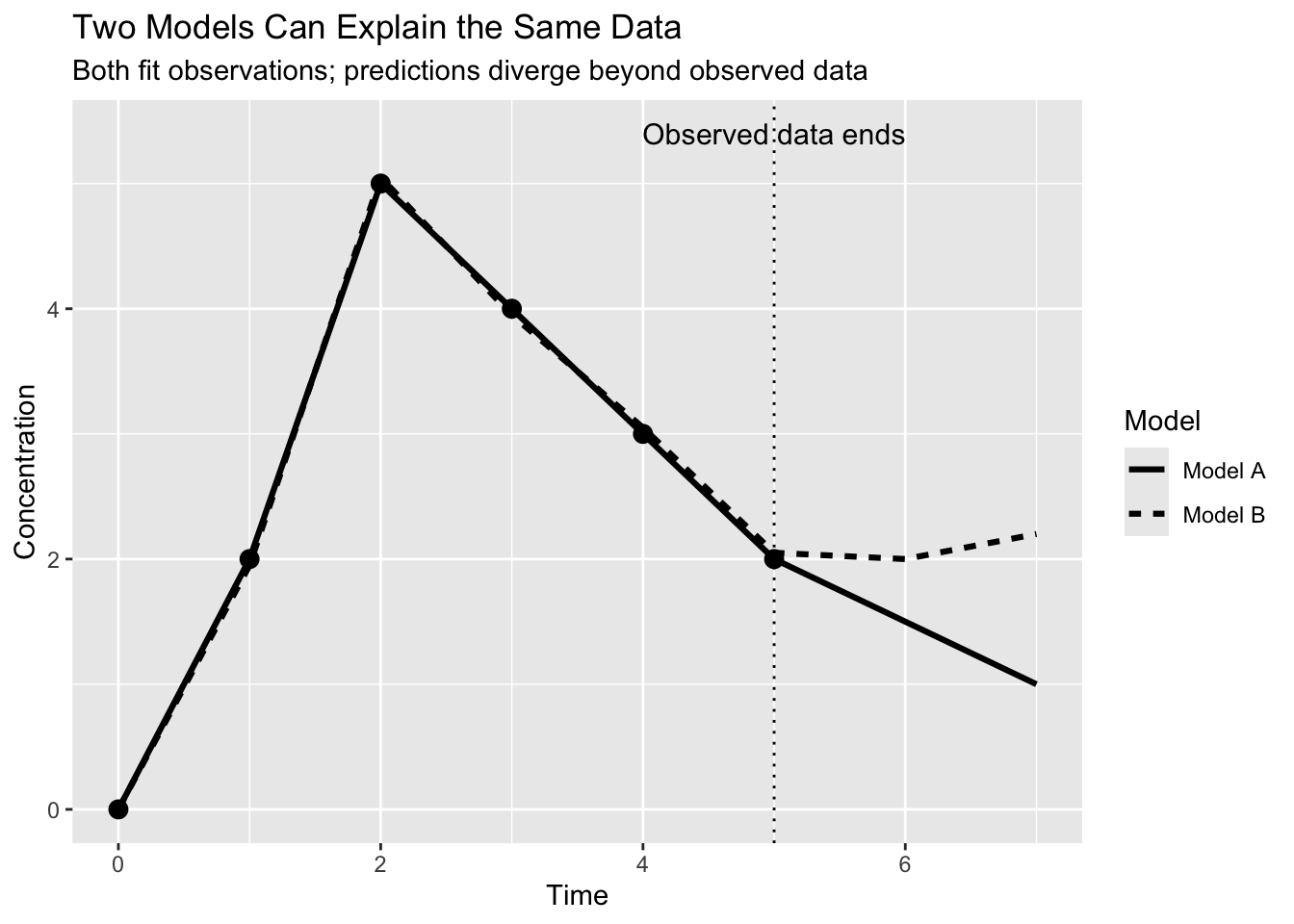
Imagine:
- Model A assumes linear elimination
- Model B assumes nonlinear elimination
Inside the observed region:
- both models appear acceptable
But beyond the observed data:
- Model A predicts continued decline
- Model B predicts changing behavior
👉 Similar fit does not guarantee similar decisions.
Expanding the Example
Evaluation asks a different question from estimation.
Estimation asks:
“Can the model explain observed data?”
Evaluation asks:
“Will the model remain reliable when used?”
A model can be:
- descriptively adequate (fits observations)
- predictively unreliable (fails outside observed conditions)
This often occurs because:
- assumptions are incorrect
- structure is misspecified
- variability is poorly represented
Insight
Model evaluation is about understanding not just fit, but reliability.
Note
Always ask:
“Will this model still work outside the observed data?”
The following lessons introduce diagnostic tools used to answer that question.
Types of Assumptions
Structural Assumptions
- compartment structure
- functional forms
Statistical Assumptions
- distribution of variability
- residual error
Data Assumptions
- measurement accuracy
- sampling design
Each can fail independently.
Why This Matters for Decisions
Models are used for:
- dose selection
- trial design
- regulatory justification
If a model is wrong:
- doses may be incorrect
- risks may be underestimated
- decisions may fail
Strategies
- Evaluate models from multiple perspectives
- Focus on prediction, not just fit
- Question assumptions explicitly
- Compare alternative models
Common Mistakes
- Trusting models solely based on fit
- Ignoring assumptions
- Over-relying on numerical output
- Confusing fit with validity
Practice Problems
- Why is model evaluation necessary?
- Can a model fit data well and still be wrong?
- What types of assumptions do models rely on?
TipStep-by-Step Solutions
- Because fitting alone does not guarantee correctness or predictive ability
- Yes, if assumptions are incorrect
- Structural, statistical, and data assumptions
Summary
Model evaluation:
- tests whether a model is reliable
- identifies assumption failures
- connects modeling to decision-making
A model is only useful if it remains reliable for the decision it supports.
TipQuick Tips
- Fit ≠ truth
- Always question assumptions
- Evaluate predictions, not just fit
- Use multiple diagnostics
- Models support decisions—not replace thinking