Time-to-Event and Disease Progression Models
Understand how pharmacometric models extend beyond concentration and effect to capture event timing and disease dynamics.
Tip
What you’ll build today: a clear understanding of how pharmacometrics models when events happen and how disease evolves over time.
Learning Objectives
By the end of this lesson, you will be able to:
- Define time-to-event (TTE) models
- Understand disease progression models
- Distinguish event timing vs continuous response
- Recognize when these models are needed
Key Ideas
So far, you’ve seen:
- PK → concentration
- PD → effect
Now we extend further:
What happens over time at the clinical level?
This includes:
- When an event occurs (e.g., death, relapse)
- How disease changes over time
Extending the Modeling Chain
Pharmacometrics often expands from:
Dose
↓
PK
↓
PD
↓
Clinical Outcome
But clinical outcomes can appear in different forms:
- continuous outcomes → disease progression
- event outcomes → time-to-event
This allows pharmacometric models to connect biology to real patient outcomes.
Why This Lesson Matters
Not all outcomes are:
- continuous (like concentration)
- directly observable at every time
Many are:
- discrete events
- long-term disease changes
Example:
- Time until tumor progression
- Time until adverse event
- Disease severity over months
Time-to-Event (TTE) Models
TTE models focus on:
When does an event occur?
Instead of modeling magnitude, we model:
- probability of event over time
Hazard Concept
Key idea:
- hazard = instantaneous risk of event
Conceptually:
\[ h(t) = \text{instantaneous event risk at time }t \]
Interpretation:
- higher hazard → event more likely soon
- lower hazard → event less likely soon
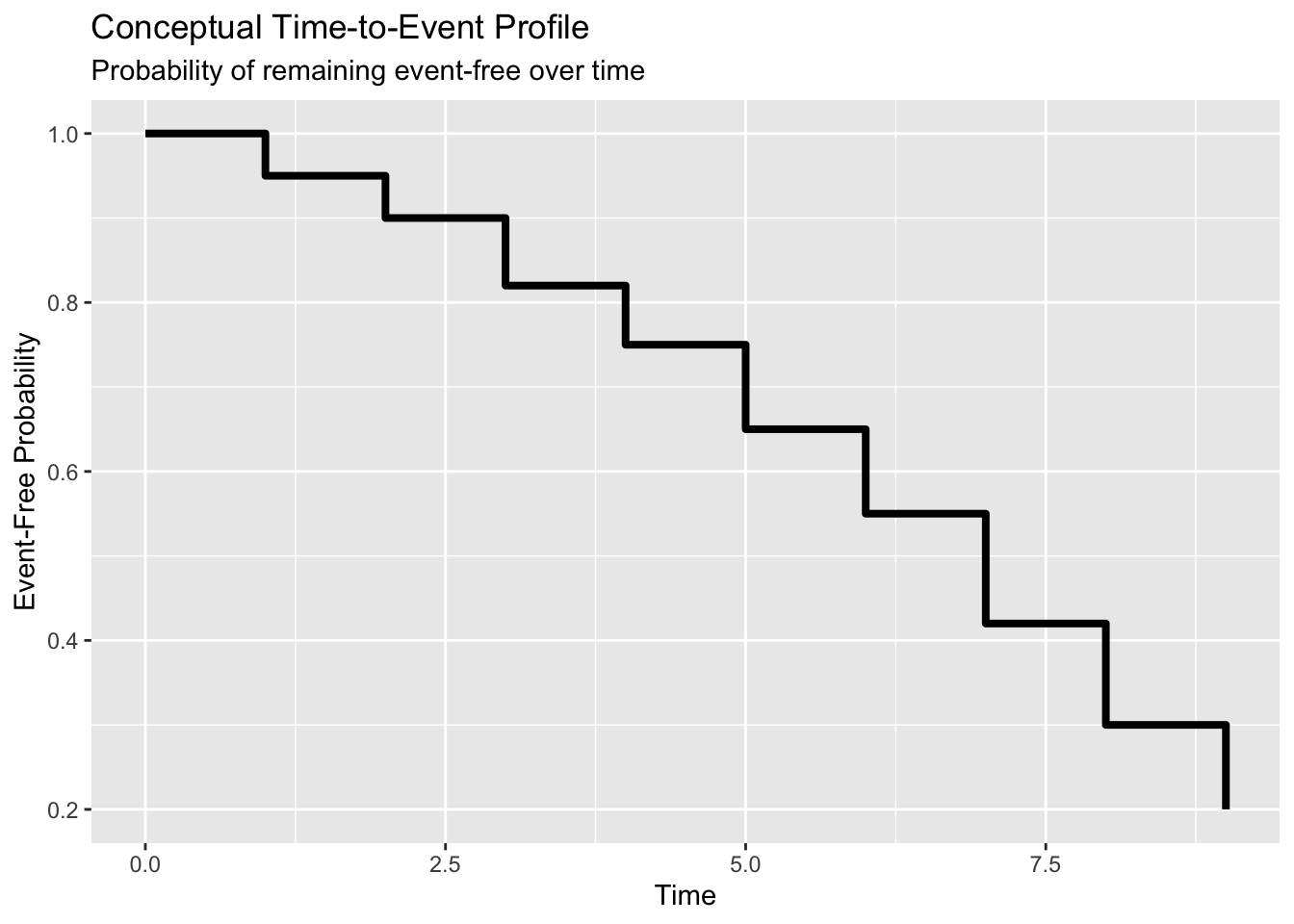
Worked Example: Event Timing
Interpretation:
- early times → most individuals remain event-free
- later times → more events accumulate
TTE models aim to explain and predict this behavior.
Disease Progression Models
These models describe:
How disease changes over time
Examples:
- Tumor growth
- Biomarker progression
- Functional decline
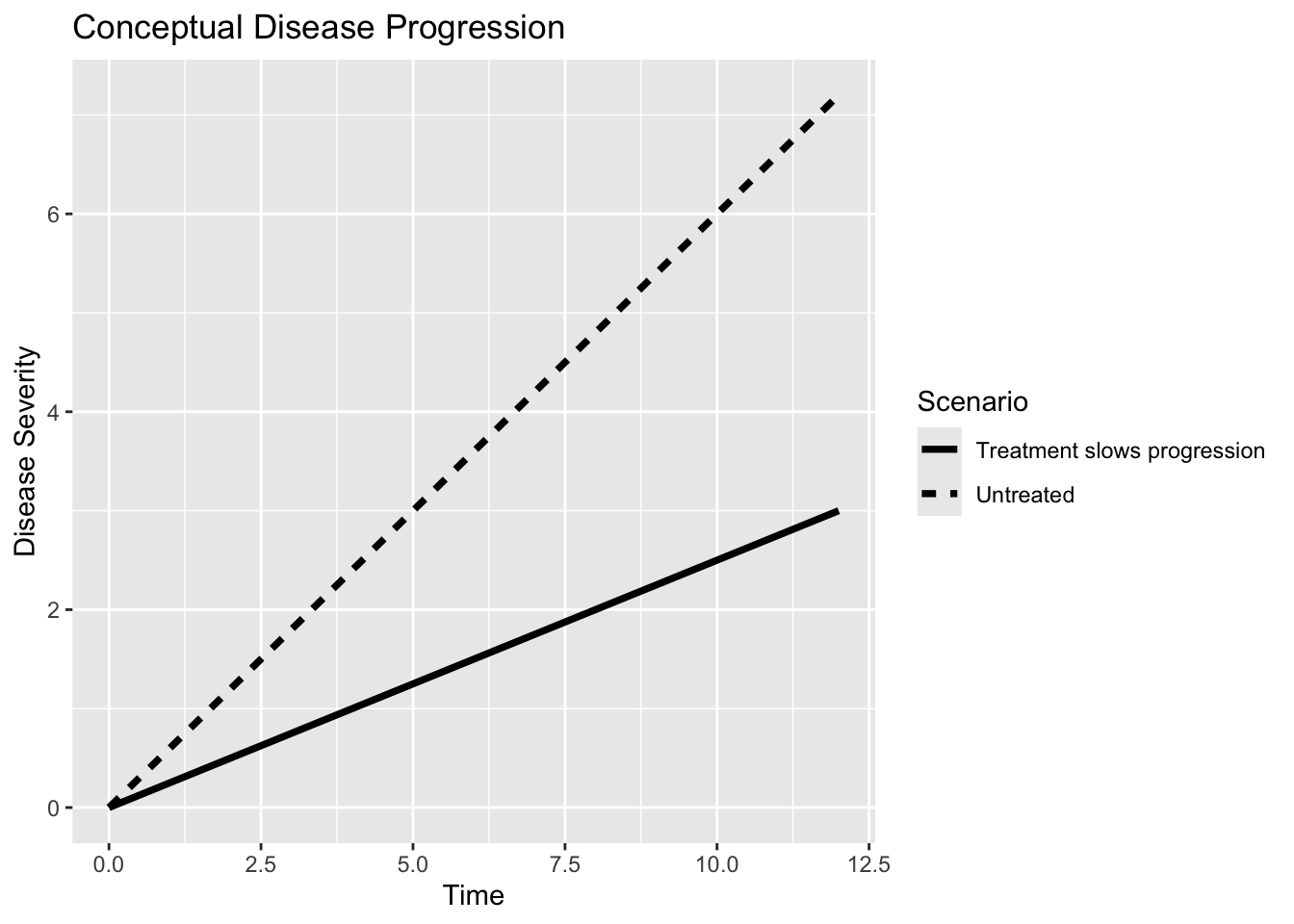
Interpretation:
- untreated → disease worsens over time
- treatment → changes the trajectory
Insight
Disease progression provides the underlying trajectory, while treatment modifies it.
Note
Drug effect is often modeled as a deviation from natural disease progression.
Expanding the Idea
You can combine:
- disease progression + treatment effect
- exposure–response + time dynamics
This allows modeling:
- slowing disease
- delaying events
- improving outcomes
Why This Matters for Decisions
These models support:
- clinical trial endpoints
- survival analysis
- long-term predictions
Example:
- Does treatment delay progression?
- Does it improve survival?
Strategies
- Use TTE for event-based outcomes
- Use progression models for longitudinal disease
- Combine with exposure when needed
Common Mistakes
- Treating event timing like continuous data
- Ignoring censoring
- Misinterpreting hazard
Practice Problems
- What does a TTE model describe?
- What is disease progression?
- Why are these models important?
TipStep-by-Step Solutions
- Timing of events
- Change in disease over time
- They capture clinically meaningful outcomes
Summary
TTE and disease progression models:
- extend PMx beyond PK/PD
- focus on clinical outcomes
- capture time dynamics
TipQuick Tips
- TTE = when events happen
- Disease progression = how disease changes
- Time is central
- Combine with exposure when needed