What is Noncompartmental Analysis (NCA)?
Understand what NCA is, why it exists, and how it differs fundamentally from model-based approaches.
Tip
What you’ll build today: a clear mental model of NCA as a data-driven framework for quantifying exposure—and when it is the right (or wrong) tool.
Learning Objectives
By the end of this lesson, you will be able to:
- Define noncompartmental analysis (NCA) in practical terms
- Distinguish NCA from compartmental modeling
- Understand what questions NCA can answer
- Recognize when NCA supports (or fails to support) decisions
Key Ideas
Noncompartmental Analysis (NCA) is a data-driven framework for summarizing drug exposure.
It works directly with observed concentration–time data to compute:
- total exposure
- peak concentration
- timing of key events
Critically, NCA:
- does not assume a structural model
- does not attempt to explain mechanisms
- does not separate system behavior into parameters like CL or V
Insight: NCA is not a simplified model—it is a different way of thinking about data entirely.
Warning
It is easy to think NCA is “just a quick model.”
In reality, NCA avoids modeling altogether and instead summarizes what was observed.
What Does NCA Extract?
NCA works directly on observed concentration–time data.
Instead of explaining the system, it summarizes key observable features.
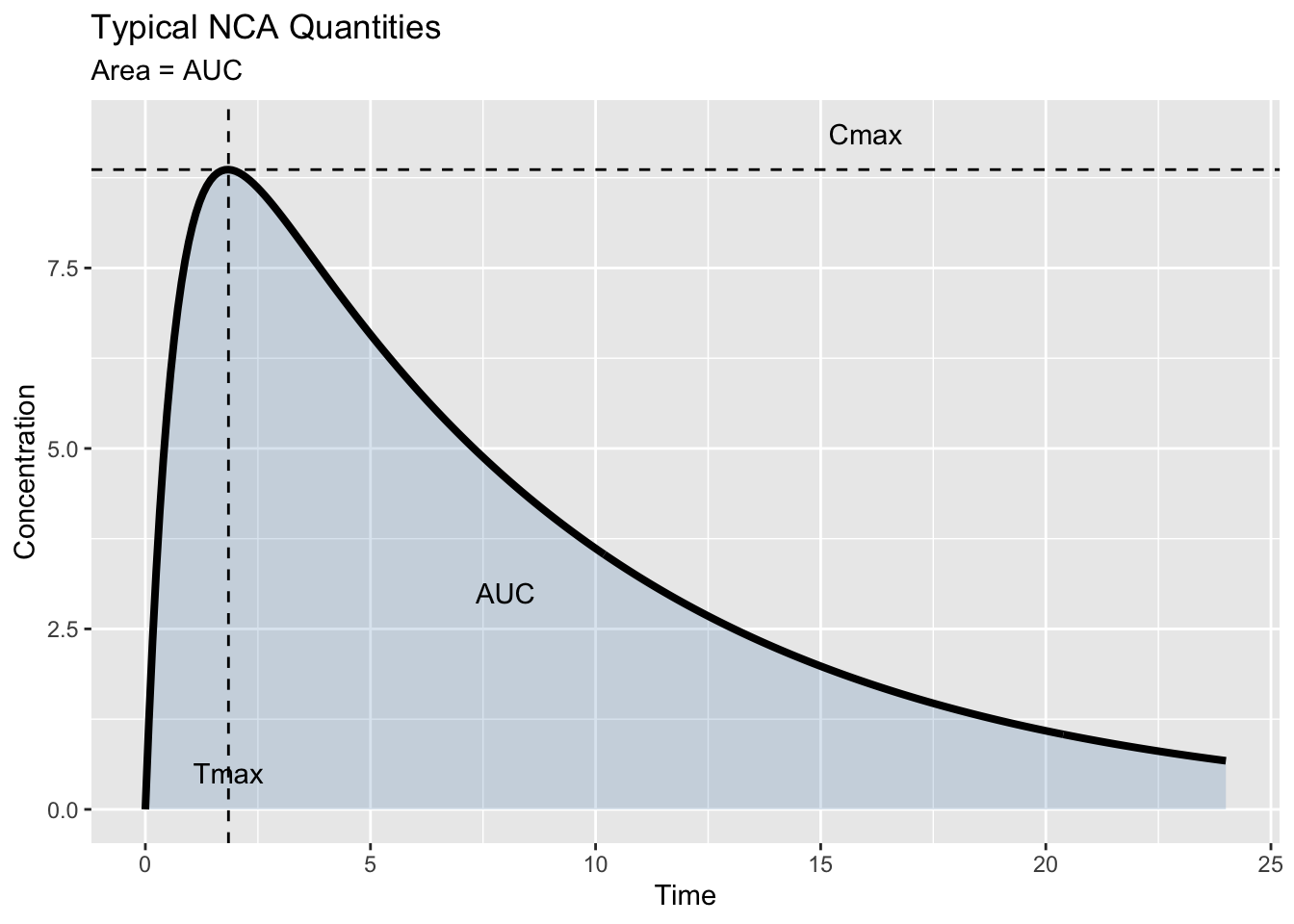
NCA summarizes observed profiles into quantities such as:
- AUC → total exposure (area under curve)
- Cmax → highest observed concentration
- Tmax → time of highest observed concentration
Why This Lesson Matters
The same dataset can be analyzed using:
- NCA → descriptive exposure summaries
- modeling → mechanistic interpretation and prediction
These lead to different conclusions and decisions.
This means:
Choosing NCA is not just a convenience—it is a decision about what questions you are asking.
NCA vs Modeling: The Core Distinction
NCA
- Describes observed data
- Minimal assumptions
- No explicit system structure
- Produces summary metrics
Modeling
- Explains data using system structure
- Requires assumptions
- Enables prediction and simulation
- Produces interpretable parameters
flowchart LR

D[Observed Data]

D --> N[NCA]

D --> M[Modeling]

N --> S[Summaries]

M --> P[Parameters + Prediction]
Same observations.
Different questions.
Different outputs.
Worked Example: Same Data, Different Questions
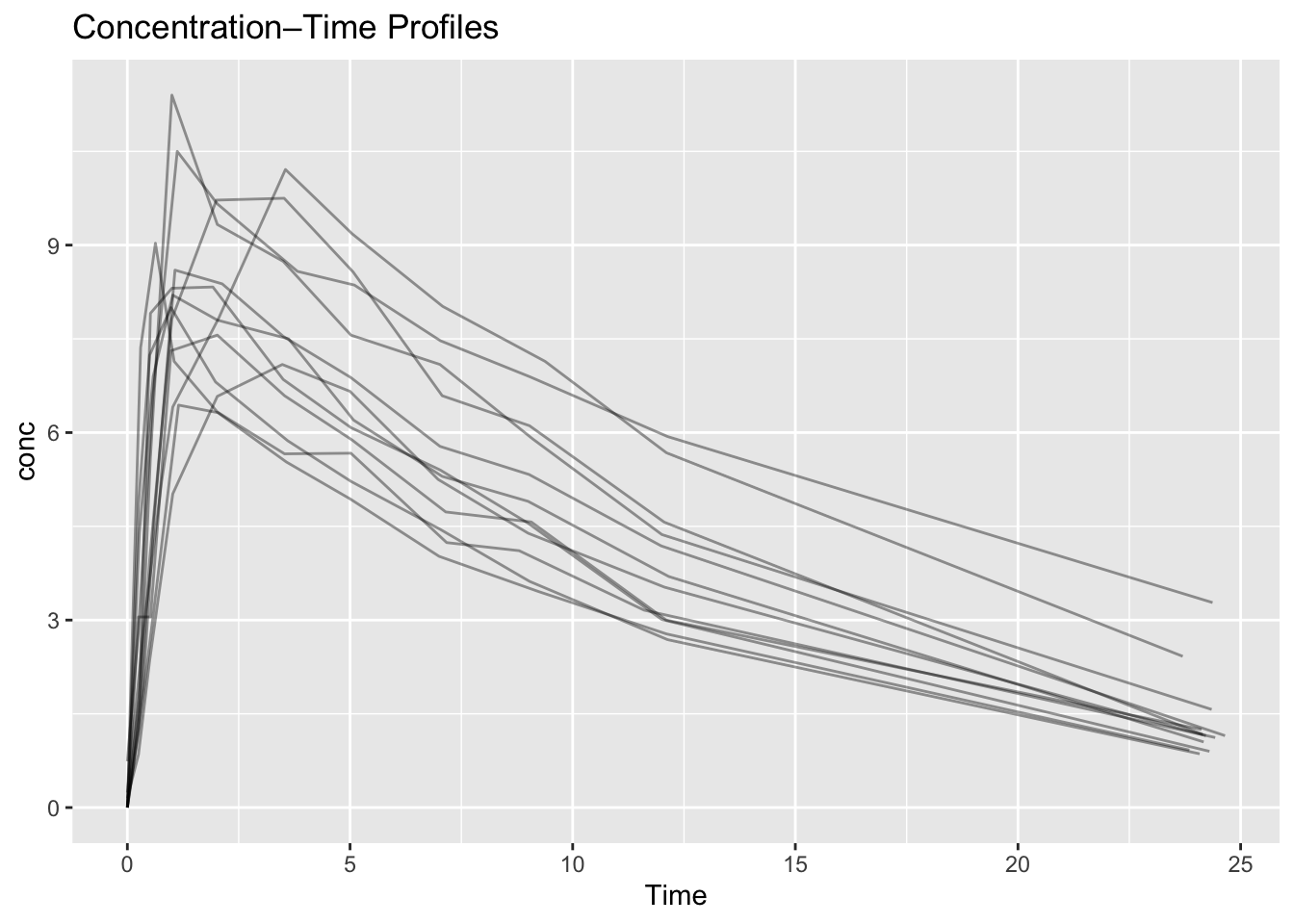
Using NCA, you would ask:
- What is the AUC?
- What is Cmax?
- What is Tmax?
Using modeling, you would ask:
- What is clearance?
- What is volume?
- What mechanism explains the curve?
👉 Same data, completely different interpretations.
Expanding the Example
Suppose your question is:
| Question | NCA | Modeling |
|---|---|---|
| What was exposure? | ✓ | ✓ |
| What was Cmax? | ✓ | ✓ |
| Predict new regimen? | ✗ | ✓ |
| Simulate future trial? | ✗ | ✓ |
| Estimate CL or V? | ✗ | ✓ |
Notice something important:
NCA is not “less advanced.”
It answers a different class of questions.
Choose the approach based on the decision—not on complexity.
Insight
A powerful way to think about NCA:
NCA compresses a full concentration–time profile into a small set of summary numbers.
This compression is useful—but it comes with tradeoffs.
Note
Those summaries can hide important structure, variability, or failure modes in the data.
What NCA Does Well
- Summarizes exposure (AUC, Cmax, Tmax)
- Supports bioequivalence and regulatory analyses
- Requires minimal assumptions
- Provides fast, interpretable results
What NCA Cannot Do
- Explain mechanisms
- Predict unobserved scenarios
- Separate structural vs variability effects
- Handle complex dosing or sparse data reliably
Decision Implications
NCA supports decisions like:
- Are two formulations equivalent?
- Does exposure increase with dose?
- Is exposure within an acceptable range?
But it cannot answer:
- What happens if we change the dosing schedule?
- How will exposure change in a new population?
👉 That boundary is critical.
Common Problem Types
- Sparse sampling leading to unreliable AUC
- Poorly defined terminal phase
- Over-reliance on summary metrics
- Misinterpretation of exposure measures
Strategies
- Use NCA when the goal is description
- Ensure adequate sampling (especially terminal phase)
- Interpret results in context of data quality
- Recognize when modeling is required
Common Mistakes
- Treating NCA as a modeling approach
- Over-interpreting summary metrics
- Ignoring assumptions behind AUC estimation
- Using NCA for predictive questions
Practice Problems
- What type of questions is NCA best suited to answer?
- How does NCA differ fundamentally from modeling?
- When is NCA not appropriate?
TipStep-by-Step Solutions
- Questions about observed exposure (AUC, Cmax, Tmax)
- NCA describes data; modeling explains and predicts
- When prediction or mechanistic understanding is required
Summary
NCA is:
- data-driven
- assumption-light
- descriptive
It provides:
- exposure summaries
- fast, practical insights
But it does not:
- explain
- predict
Choosing NCA is ultimately choosing what questions you want to answer.
TipQuick Tips
- NCA = description, not explanation
- Use for exposure summaries
- Avoid for prediction
- Always check data quality
- Know when to switch to modeling