AUC Calculation and Interpretation
Understand how AUC is computed in practice, how sampling affects it, and how extrapolation introduces risk.
Tip
What you’ll build today: a clear understanding of how AUC is calculated from real data, what assumptions are involved, and when AUC becomes unreliable.
Learning Objectives
By the end of this lesson, you will be able to:
- Explain how AUC is calculated using the trapezoidal rule
- Understand how sampling design impacts AUC
- Interpret extrapolated AUC (AUCinf)
- Recognize when AUC estimates are unreliable
Key Ideas
AUC is defined as:
\[ AUC = \int C(t) \, dt \]
But in practice, we do not have continuous data.
We only observe concentrations at discrete time points, so we must approximate the integral from observed data.
Insight: AUC is not read directly from the body. It is inferred from sampled observations.
Warning
If sampling is poor, AUC can be biased even when the underlying pharmacokinetics are unchanged.
Why This Lesson Matters
AUC is one of the most widely used exposure metrics in pharmacometrics.
It supports decisions such as:
- dose comparisons
- bioequivalence
- exposure–response interpretation
- regulatory summaries
But those decisions are only as reliable as the AUC estimate itself.
That means you need to understand not just what AUC means, but how it is built from the data.
The Trapezoidal Rule
Because concentrations are observed at discrete times, AUC is usually approximated with the trapezoidal rule:
\[ AUC \approx \sum_i \frac{C_i + C_{i+1}}{2}(t_{i+1} - t_i) \]
Interpretation:
- each pair of adjacent points defines a trapezoid
- each trapezoid contributes area
- total AUC is the sum of all those areas
This is conceptually simple, but its quality depends on the data.
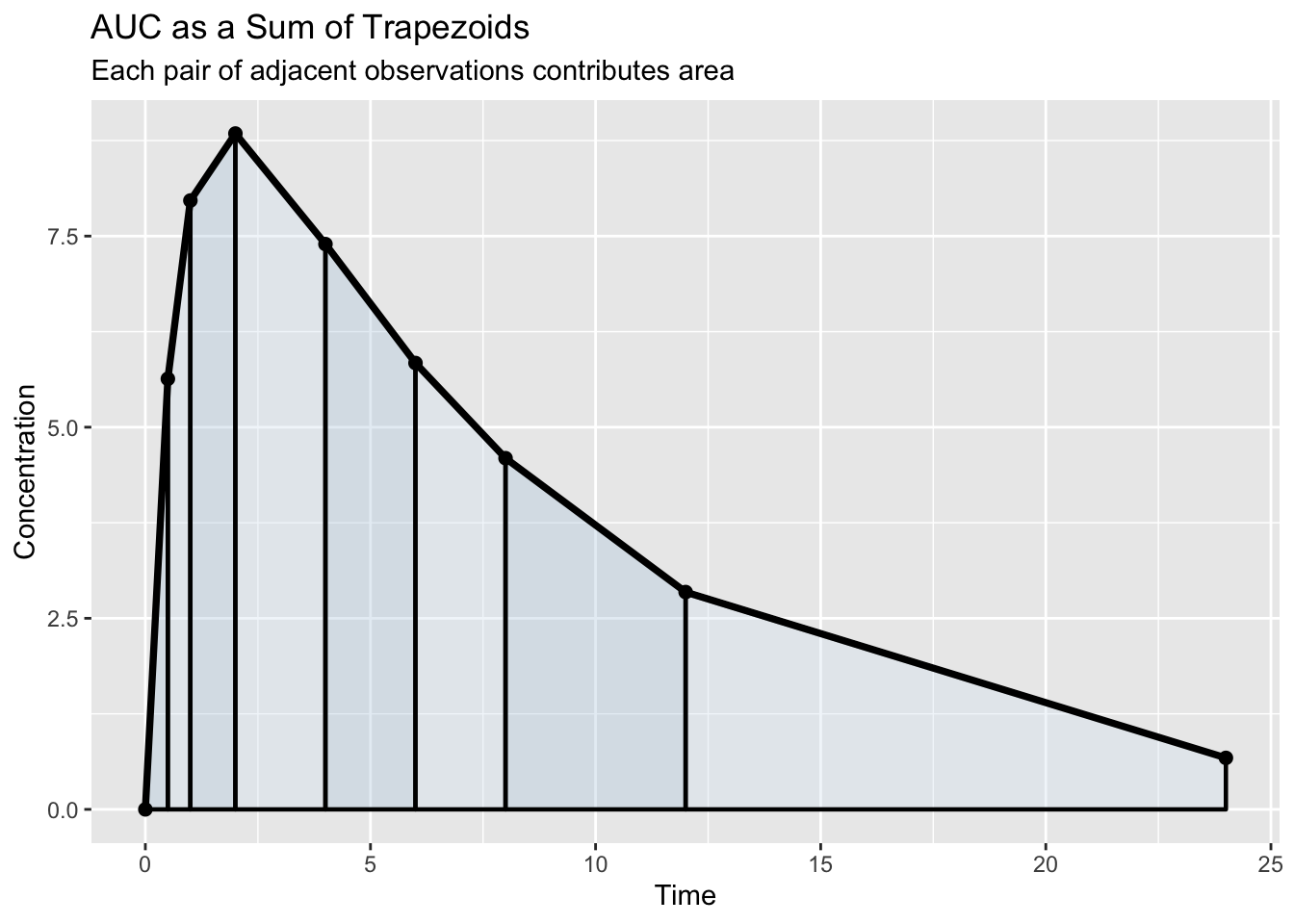
Worked Example: Visual Intuition
To understand trapezoidal AUC, it helps to see how the area is built.
Now AUC becomes visually interpretable:
- each neighboring pair of points forms one trapezoid
- each trapezoid contributes exposure
- total AUC is the sum of all trapezoids
Expanding the Example: Why Single-Profile Thinking Matters
If you connect points from multiple individuals in one line, the figure becomes misleading:
- segments no longer represent one real PK profile
- the implied AUC is not interpretable
- the plot suggests continuity where none exists
That is why AUC should always be understood within a single profile.
For theory, one clean individual profile is much better than a pooled line across subjects.
Sampling Density and AUC Quality
The trapezoidal rule works best when the profile is sampled well.
Dense sampling
- more points
- smaller trapezoids
- better approximation
Sparse sampling
- fewer points
- larger trapezoids
- more approximation error
Insight: AUC is partly a property of the drug and partly a property of the sampling design.
Note
A useful question is: “Would this AUC change meaningfully if I had sampled more densely?”
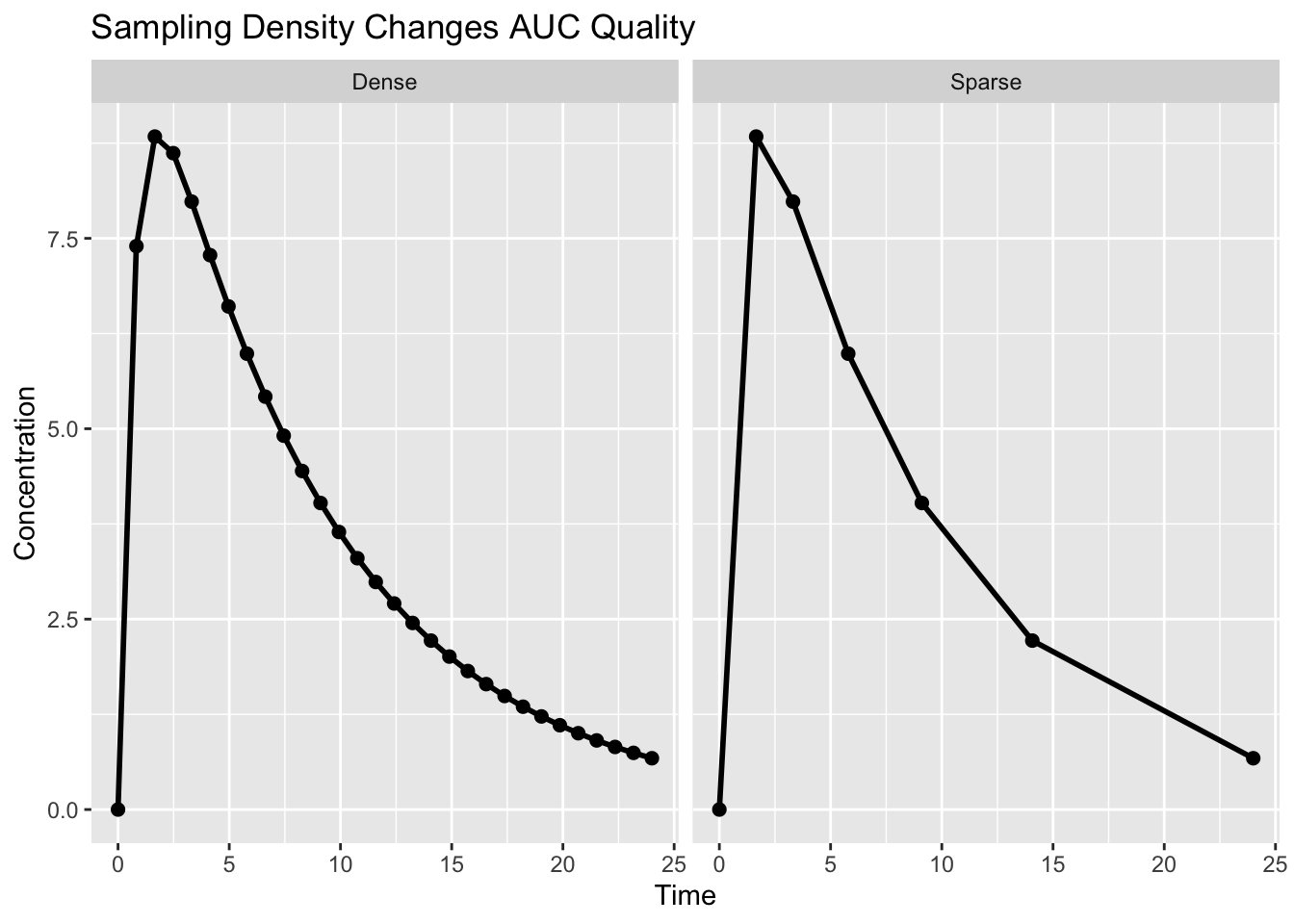
Smaller trapezoids usually produce better approximations.
Extrapolated AUC (AUCinf)
In many studies, data do not continue all the way until concentration is effectively zero.
So the total AUC to infinity is estimated as:
\[ AUC_{inf} = AUC_{last} + \frac{C_{last}}{\lambda_z} \]
Where:
- \(AUC_{last}\) = observed AUC up to the last measured point
- \(C_{last}\) = last observed concentration
- \(\lambda_z\) = terminal slope
This means part of AUCinf is observed, and part is estimated.
flowchart LR

OBS["Observed AUC"]

OBS -->

TOTAL["AUCinf"]

TAIL["Extrapolated tail"]

TAIL -->

TOTAL
Total exposure is partly observed and partly estimated.
Interpretation of Extrapolation
If the extrapolated portion is small:
- AUCinf is usually more credible
If the extrapolated portion is large:
- the estimate depends heavily on assumptions about the terminal phase
- reliability decreases
At that point, the result is no longer strongly data-driven.
Warning
AUCinf can look precise numerically even when it is driven mainly by extrapolation rather than observed data.
Why This Matters for Decisions
AUC is often treated as a definitive exposure measure.
But if it is based on:
- sparse sampling
- weak terminal phase definition
- large extrapolated fraction
then the decision based on it may be weak as well.
That is why AUC interpretation is never just about the formula. It is about the quality of the profile underneath it.
Common Problem Types
- Sparse sampling across important parts of the profile
- Large trapezoids created by wide spacing between samples
- Poorly defined terminal phase
- High extrapolated fraction in AUCinf
- Noisy late-time observations
Strategies
- Use sufficiently dense sampling when AUC is important
- Inspect the profile visually before trusting the number
- Check whether the terminal phase is well defined
- Report and interpret extrapolated fraction explicitly
- Treat AUC as an estimate with assumptions, not a perfect truth
Common Mistakes
- Trusting AUC without checking the sampling schedule
- Forgetting that trapezoidal AUC is an approximation
- Ignoring the extrapolated component of AUCinf
- Treating numerically precise output as automatically reliable
- Interpreting pooled or incorrectly connected data as one profile
Practice Problems
- Why is the trapezoidal rule needed in practice?
- Why is one individual profile better than a pooled line for understanding AUC?
- How does sparse sampling affect AUC estimation?
- When does AUCinf become less reliable?
TipStep-by-Step Solutions
- Because concentrations are observed at discrete time points rather than continuously.
- Because AUC is defined for a single concentration–time profile, and pooled connected lines can imply a false continuity.
- Sparse sampling creates larger trapezoids and increases approximation error.
- When a large fraction of the total AUC comes from extrapolation rather than observed data.
Summary
AUC is:
- a fundamental exposure metric
- an approximation built from sampled data
- sensitive to sampling quality and extrapolation
Understanding AUC means understanding both:
- the equation
- the profile and design underneath it
TipQuick Tips
- AUC is built from adjacent observed points.
- Use one profile, not pooled connected data, for visual intuition.
- More points usually mean a better approximation.
- Always inspect the terminal phase.
- AUCinf is part data and part assumption.