Assumptions and Failure Modes of NCA
Understand the assumptions behind NCA, when they are violated, and how that impacts interpretation and decisions.
Tip
What you’ll build today: the ability to recognize when NCA results are reliable—and when they should not be trusted.
Learning Objectives
By the end of this lesson, you will be able to:
- Identify key assumptions underlying NCA
- Understand common failure modes
- Evaluate reliability of AUC and related metrics
- Recognize when modeling is required instead of NCA
Key Ideas
NCA appears simple because it avoids explicit models.
However:
NCA still relies on implicit assumptions
If those assumptions are violated:
- AUC may be biased
- Cmax may be missed
- conclusions may be incorrect
Core Assumptions of NCA
1. Adequate Sampling
- Sufficient data points across the profile
- Especially important around:
- peak (Cmax)
- terminal phase
- peak (Cmax)
If sampling is poor:
- peak may be missed
- AUC may be underestimated
2. Well-Defined Terminal Phase
To estimate elimination:
- data must show a clear log-linear decline
This is required for:
- terminal slope (λz)
- extrapolated AUC
3. Minimal Measurement Error
NCA assumes:
- observed data reflect true concentrations
But:
- noisy data → unstable AUC
- noisy terminal phase → poor λz
Worked Example: Terminal Phase Failure
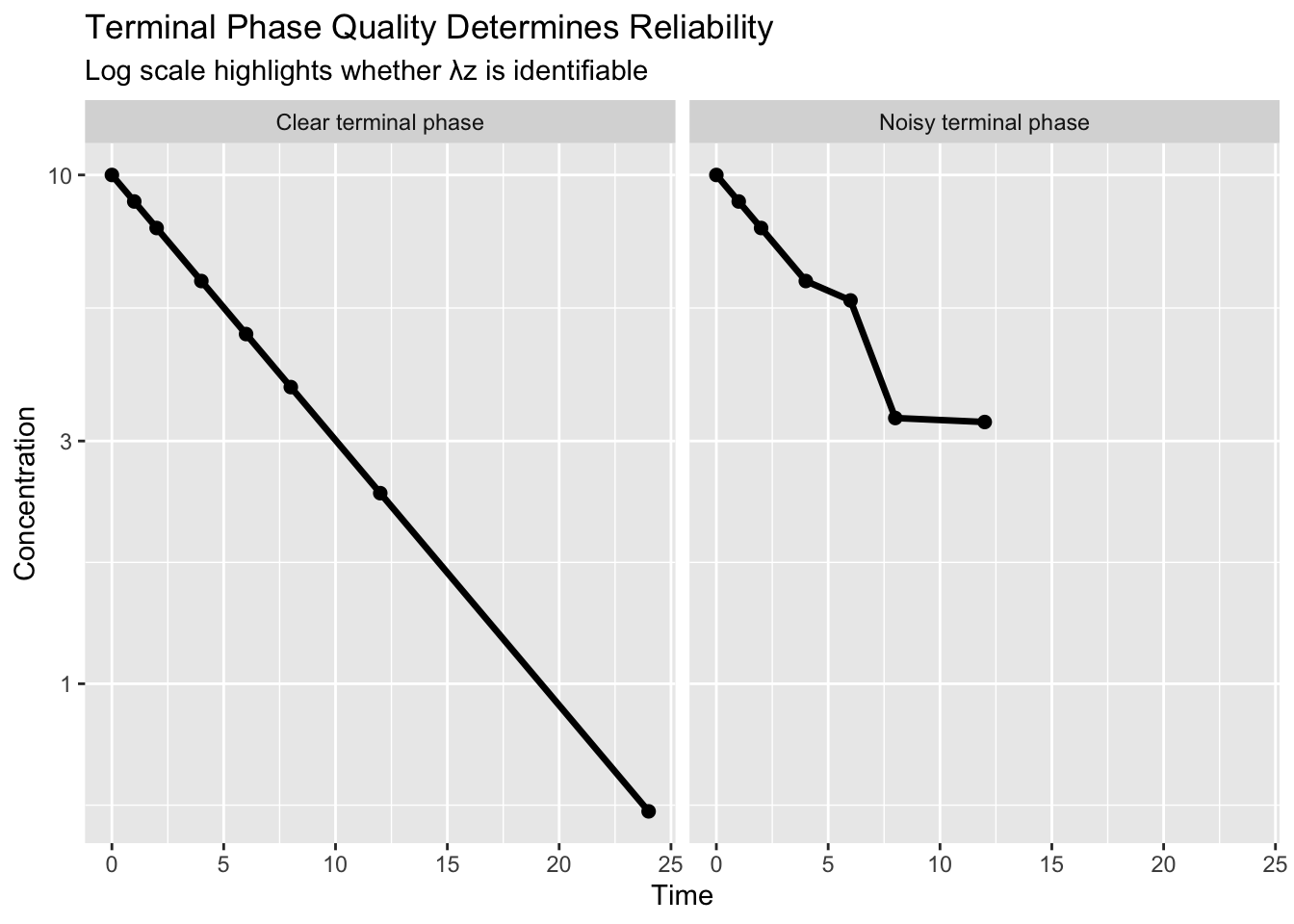
NCA assumes the terminal phase is sufficiently clear to estimate elimination.
Compare these two situations.
Notice:
- left → clear decline → reliable λz
- right → noisy tail → unstable λz
That instability directly affects extrapolated AUC.
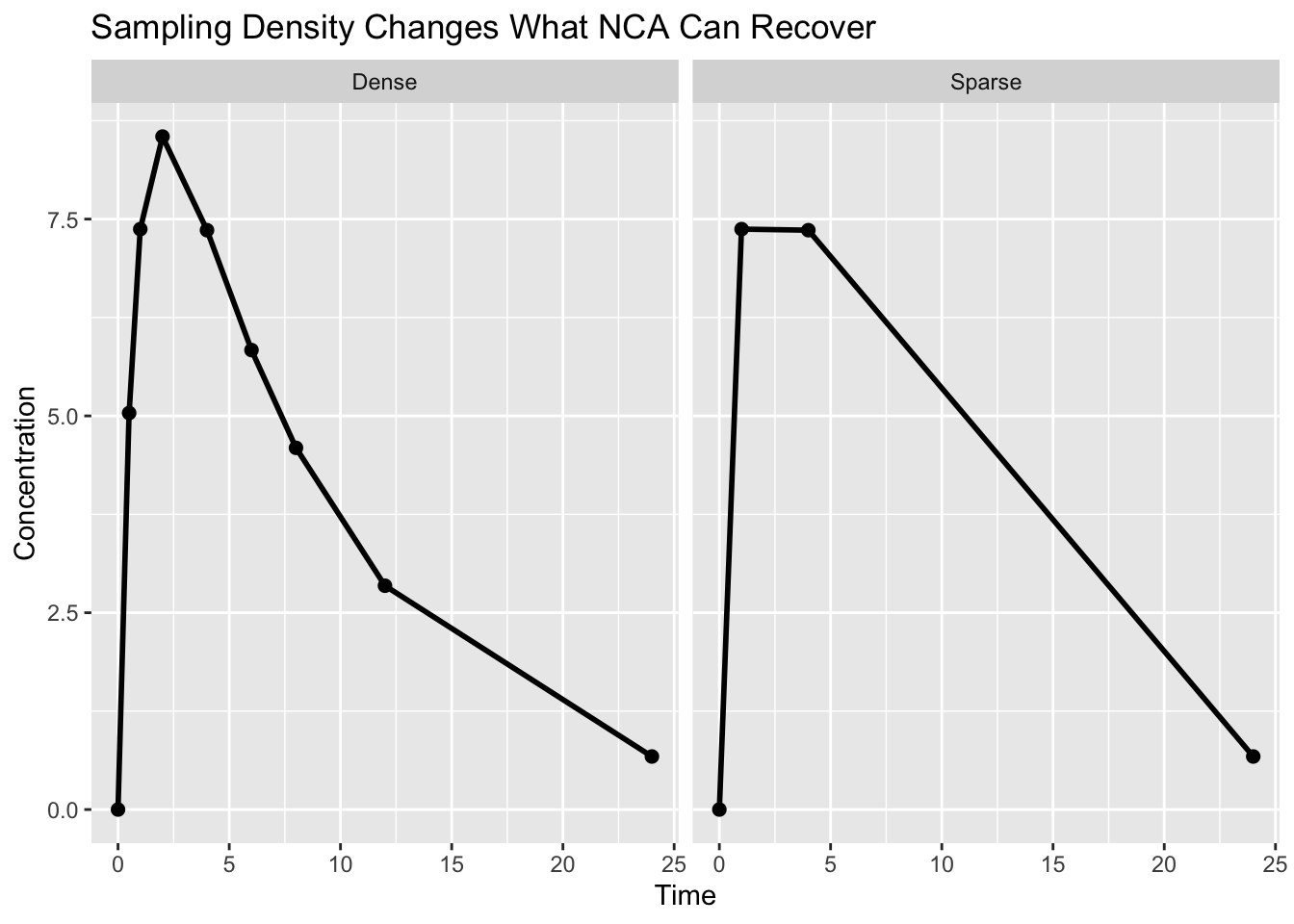
Expanding the Example: Sparse Sampling
With few samples:
- trapezoids are large
- peak may be missed
- terminal phase unclear
👉 Same drug, different sampling → different conclusions
Insight
NCA results depend as much on study design as on pharmacokinetics.
Note
Good data → reliable NCA
Poor data → misleading NCA
Extrapolation Risk
Recall:
\[ AUC_{inf} = AUC_{last} + \frac{C_{last}}{\lambda_z} \]
If:
- extrapolated portion is large
Then:
- AUC is driven by assumptions, not data
Common Failure Modes
Sparse Sampling
- unreliable AUC
- missed peak
Poor Terminal Phase
- unstable λz
- unreliable extrapolation
High Variability
- noisy profiles
- inconsistent metrics
BLQ Data (Below Limit of Quantification)
- missing tail data
- biased AUC
Flip-Flop Kinetics (Advanced)
Sometimes:
- absorption is slower than elimination
Then:
- terminal slope reflects absorption, not elimination
👉 NCA assumptions break down
Why This Matters for Decisions
If NCA assumptions fail:
- exposure comparisons may be invalid
- bioequivalence conclusions may be incorrect
- dose decisions may be unsafe
When Should You Switch to Modeling?
NCA works well when:
✓ exposure summarization is sufficient
✓ sampling is adequate
✓ assumptions are approximately satisfied
Modeling becomes attractive when:
✓ profiles are sparse
✓ extrapolation becomes substantial
✓ variability is high
✓ simulation or prediction is needed
The question is not:
“Which method is better?”
The question is:
“Which method is appropriate for the data and decision?”
Common Problem Types
- Sparse sampling → missed peak or unreliable AUC
- Poor terminal phase → unstable λz and extrapolation
- High variability → noisy exposure metrics
- BLQ data → incomplete terminal information
- Flip-flop kinetics → terminal slope reflects absorption
Strategies
- Inspect profiles visually
- Ensure dense sampling around peak and tail
- Check extrapolated AUC fraction
- Be cautious with noisy or sparse data
- Use modeling when assumptions fail
Common Mistakes
- Blindly trusting AUC values
- Ignoring terminal phase quality
- Overlooking extrapolated fraction
- Using NCA with sparse data
Practice Problems
- Why is the terminal phase important in NCA?
- What happens when sampling is sparse?
- When should you avoid using NCA?
TipStep-by-Step Solutions
- It determines λz and extrapolated AUC
- It increases error and may miss key features
- When data are sparse, noisy, or assumptions are violated
Summary
NCA is reliable only when:
- sampling is adequate
- terminal phase is clear
- extrapolation is minimal
Otherwise:
- results may be misleading
Reliable NCA depends as much on study design as on the drug itself.
TipQuick Tips
- Always inspect the data
- Check terminal phase
- Minimize extrapolation
- Don’t trust NCA blindly
- Switch to modeling when needed