Volume of Distribution (V)
Build intuition for volume of distribution and how it links amount to concentration.
Tip
What you’ll build today: a strong intuition for volume as the bridge between how much drug is in the body and what concentration you observe.
Learning Objectives
By the end of this lesson, you will be able to:
- Define volume of distribution conceptually
- Explain how volume affects concentration
- Interpret large vs small volume correctly
- Distinguish physical vs abstract meaning of volume
Key Ideas
Volume of distribution connects:
- amount of drug in the body
- observed concentration
At a conceptual level:
\[ C = \frac{Amount}{V} \]
Insight: Volume determines how “diluted” the drug appears in the body.
What Volume Really Means
Volume is often misunderstood.
It does NOT mean:
- physical body volume
- actual anatomical space
Instead, it reflects:
how extensively drug appears to distribute relative to plasma
Worked Example: Same Amount, Different Volume
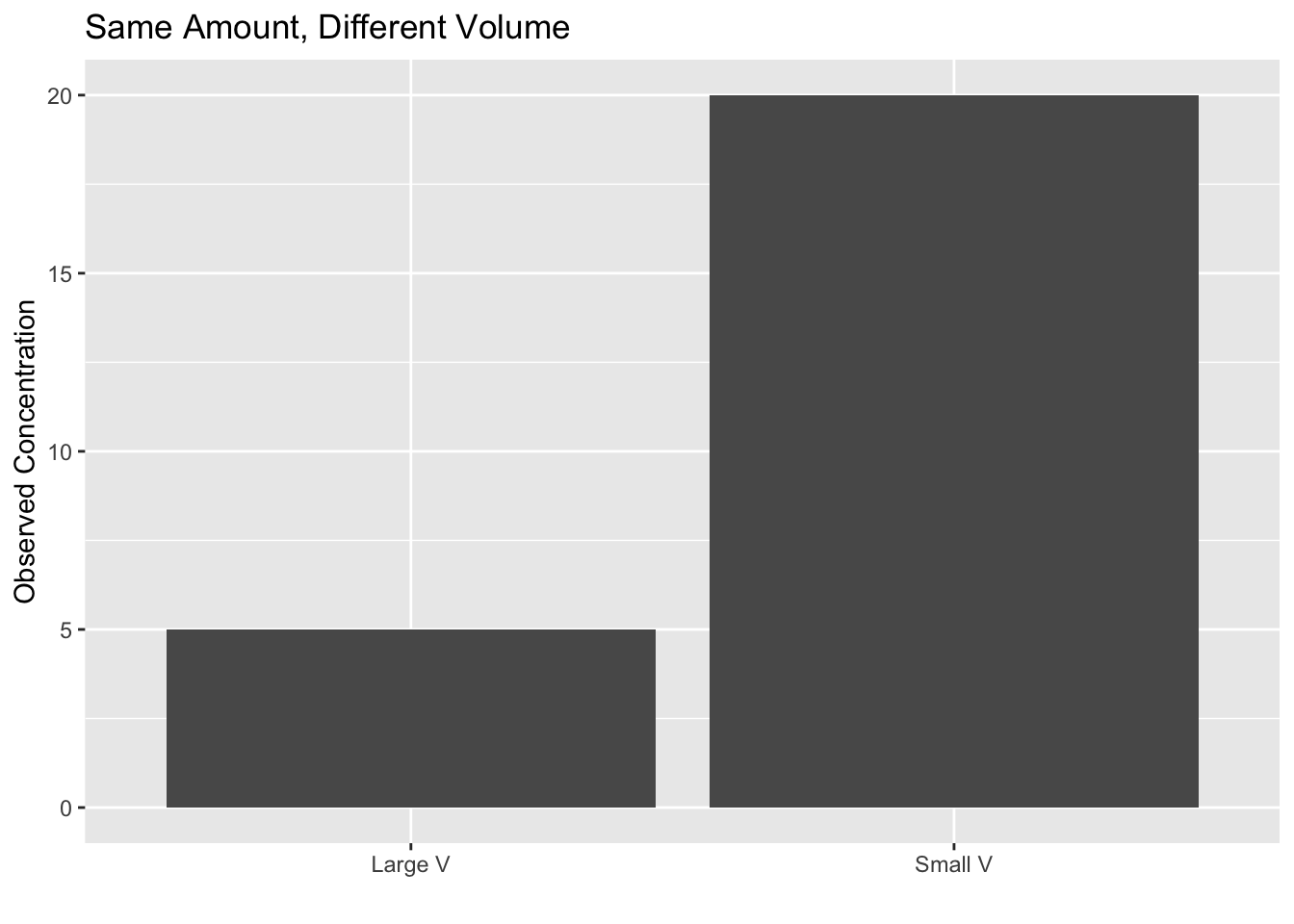
Imagine two patients with the same amount of drug.
Only volume changes.
Both patients contain the same total amount of drug.
But concentration differs.
Why?
Because concentration depends on how much volume the drug appears to occupy.
Smaller volume → higher concentration
Larger volume → lower concentration
Expanding the Example
Now imagine keeping the amount fixed while changing volume.
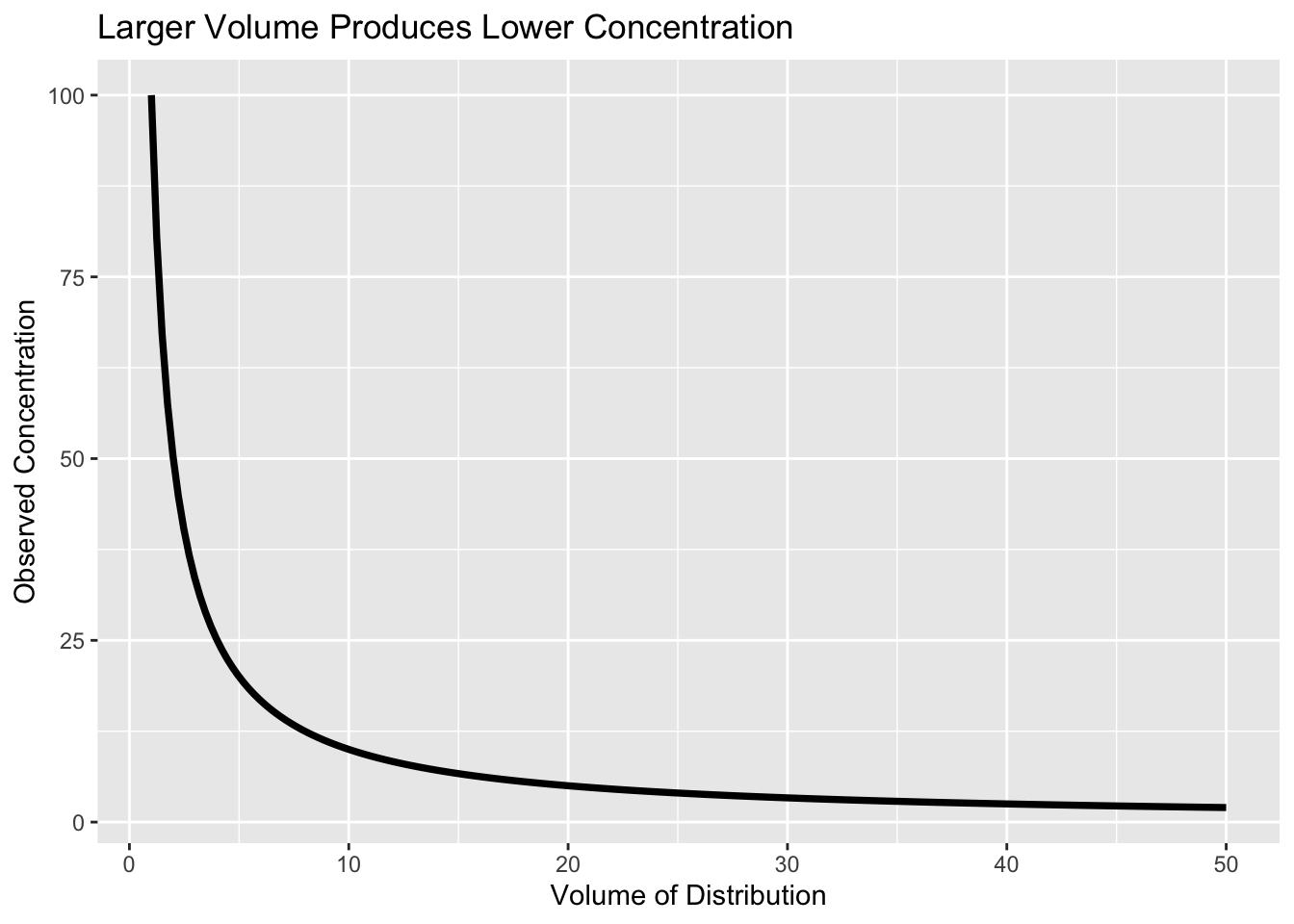
Notice:
- amount stays unchanged
- concentration falls as volume increases
That does not mean drug disappeared.
It means the same amount now appears more distributed relative to plasma.
This leads to a key idea:
Volume changes concentration without changing total amount.
Clinical Interpretation
Volume helps explain:
- why some drugs have very low plasma concentrations
- why others remain concentrated in blood
- how distribution affects interpretation of exposure
It is especially important for:
- loading dose calculations because loading dose is directly influenced by volume of distribution
- interpreting early concentration levels
Insight
A useful mental model:
Volume tells you how concentrated the drug appears relative to plasma.
Note
Always ask: “Is the concentration low because there is little drug—or because it is widely distributed?”
Strategies
- Interpret volume relative to concentration, not anatomy
- Compare volume across drugs or subjects
- Consider how distribution affects early profile shape
- Link volume to observed concentrations
Common Mistakes
- Treating volume as a physical space
- Assuming large volume means “large body size”
- Confusing low concentration with low exposure
- Ignoring the role of distribution in early data
Practice Problems
- If volume increases (same amount), what happens to concentration?
- Why is volume not a physical measurement?
- What does a large volume suggest about distribution?
TipStep-by-Step Solutions
- Concentration decreases
- Because it is a conceptual parameter, not anatomical space
- That drug appears widely distributed relative to plasma
Summary
Volume of distribution determines how concentration relates to amount.
- Large V → lower concentration
- Small V → higher concentration
Understanding volume helps you correctly interpret:
- observed concentrations
- distribution behavior
- early PK profiles
TipQuick Tips
- V links amount → concentration
- Large V = more “spread out”
- Small V = more “concentrated”
- V is abstract, not anatomical
- Always interpret concentration in context of V