flowchart LR

V["Volume (stores drug)"]
-->
HL["Half-life"]

CL["Clearance (removes drug)"]
-->
HL
Half-Life (t1/2)
Understand how half-life emerges from clearance and volume, and how to interpret it correctly.
Tip
What you’ll build today: a clear understanding that half-life is not independent—it emerges from clearance and volume.
Learning Objectives
By the end of this lesson, you will be able to:
- Define half-life conceptually
- Explain how clearance and volume determine half-life
- Interpret changes in half-life correctly
- Avoid common misinterpretations of half-life
Key Ideas
Half-life describes:
how long it takes for concentration to decrease by half
But critically:
Half-life is not an independent property
It is determined by clearance and volume.
The Core Relationship
\[ t_{1/2} = \frac{0.693 \cdot V}{CL} \]
Insight: Half-life depends on both how drug is removed (CL) and how it is distributed (V).
A Useful Mental Model
Think of half-life as a balance:
- larger V → longer persistence
- larger CL → shorter persistence
Worked Example: Different Paths to Different Half-Lives
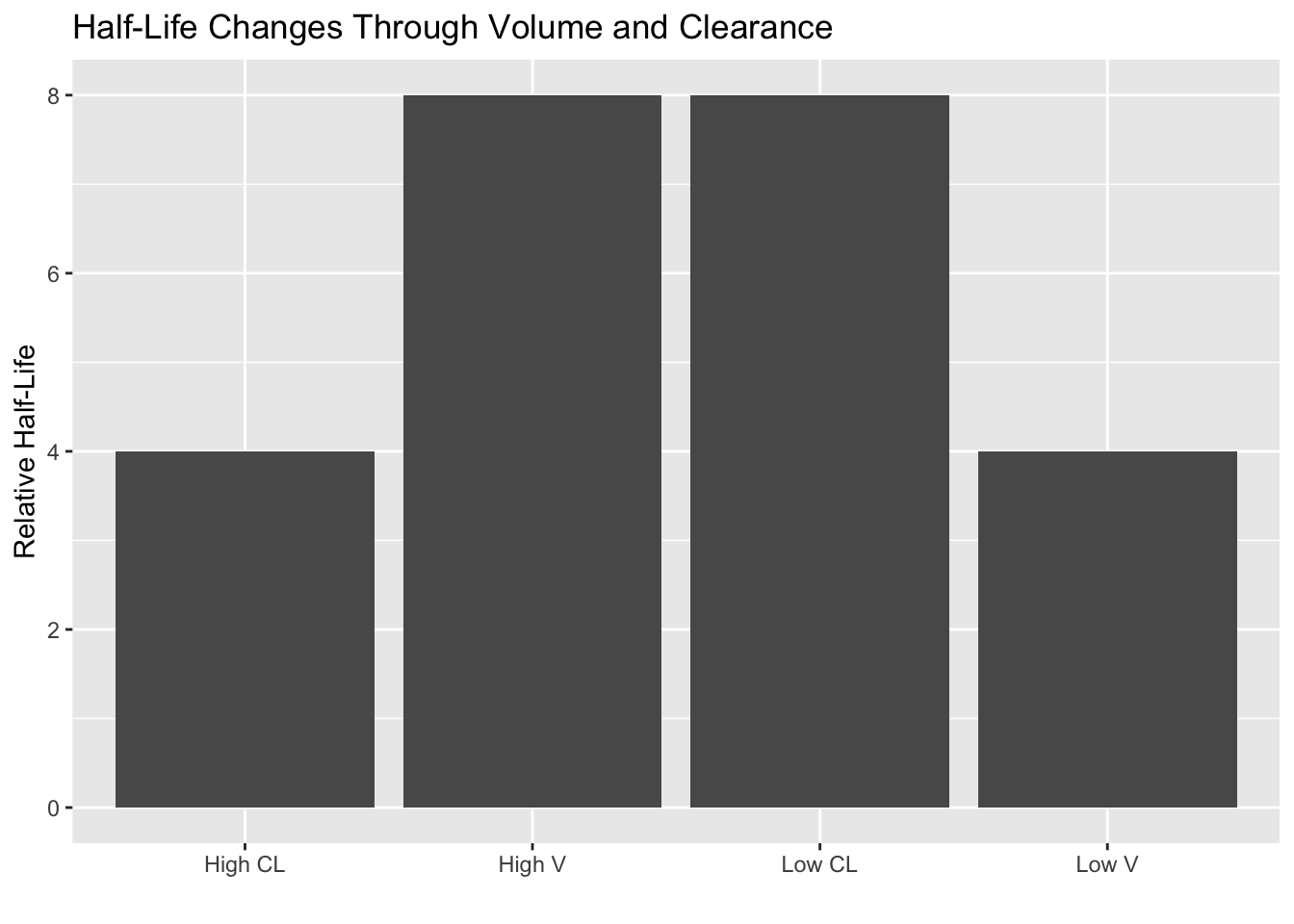
Notice:
- increasing V lengthens half-life
- increasing CL shortens half-life
Half-life itself does not explain why.
CL and V do.
Expanding the Insight
This leads to one of the most important ideas in pharmacometrics:
Half-life is a result of clearance and volume — not an independent mechanism
That means half-life tells you:
- how long concentration appears to persist
- how quickly concentrations decline
But half-life does not tell you:
- whether persistence comes from slow removal
- whether persistence comes from wide distribution
- which underlying process changed
Two systems can even have the same half-life for different reasons.
Example:
| Scenario | Clearance | Volume | Half-life |
|---|---|---|---|
| Drug A | Low | Low | Same |
| Drug B | High | High | Same |
Same half-life.
Different biology.
This is why half-life is useful as a summary—but not sufficient for interpretation.
Clinical Interpretation
Half-life is often used for:
- dosing interval decisions
- accumulation expectations
- time to steady state
But:
👉 It must be interpreted alongside CL and V
Insight
A powerful way to think about half-life:
Half-life reflects how long the system “holds onto” drug
But that depends on:
- how fast it removes it (CL)
- how widely it distributes it (V)
Note
Always ask: “Is half-life changing because of clearance, volume, or both?”
Strategies
- Always interpret half-life with CL and V together
- Consider whether changes are driven by clearance or distribution
- Use half-life as a summary, not a mechanistic explanation
- Be cautious when data are sparse in terminal phase
Common Mistakes
- Treating half-life as an independent parameter
- Using half-life alone to make decisions
- Ignoring underlying CL and V differences
- Over-relying on half-life for interpretation
Practice Problems
- What determines half-life?
- Can two systems have the same half-life but different CL and V?
- Why is half-life not sufficient on its own?
TipStep-by-Step Solutions
- Clearance and volume
- Yes, different combinations can produce the same half-life
- Because it does not reveal the underlying mechanisms
Summary
Half-life is:
- a useful summary
- but not a fundamental driver
It emerges from:
- clearance
- volume
Understanding this relationship is essential for correct interpretation.
TipQuick Tips
- t½ depends on CL and V
- Same t½ ≠ same system
- Half-life is descriptive, not causal
- Always interpret with CL and V
- Ask what is driving the change