Absorption Rate (ka)
Build intuition for absorption rate and understand how it shapes when drug appears in the body.
Tip
What you’ll build today: intuition for how absorption rate determines when drug appears in circulation and how quickly concentration rises.
Learning Objectives
By the end of this lesson, you will be able to:
- Define absorption rate conceptually
- Explain how absorption rate shapes concentration–time profiles
- Distinguish absorption from elimination
- Interpret fast vs slow absorption correctly
Key Ideas
Absorption describes:
how quickly drug moves into systemic circulation
Absorption rate is often represented by:
\[ k_a \]
where:
- larger \(k_a\) → faster appearance in circulation
- smaller \(k_a\) → slower appearance
Insight: Absorption rate affects timing, not necessarily total exposure.
Warning
Fast absorption does not automatically mean greater exposure.
Drug can appear earlier without increasing total exposure.
Why Absorption Matters
Two patients may receive:
- the same dose
- the same clearance
- the same volume
and still show very different concentration profiles.
Why?
Because concentration depends not only on removal—but also on how quickly drug enters the system.
Worked Example: Same Dose, Different Absorption Rate
Imagine two patients receive:
- the same dose
- the same bioavailability
- the same clearance
- the same volume
Only absorption rate changes.
- Patient A → fast absorption
- Patient B → slow absorption
What happens?
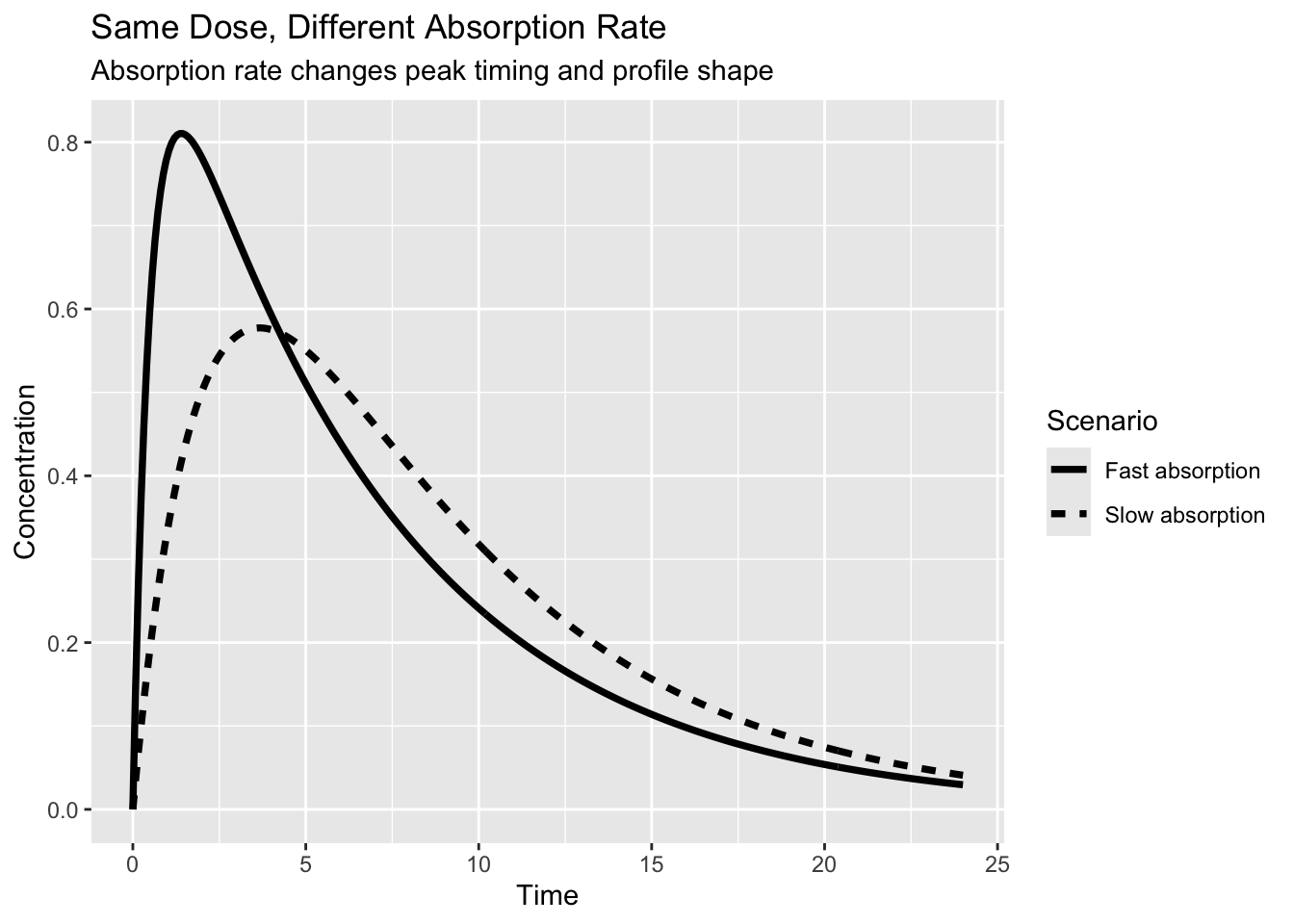
- Patient A → earlier rise and earlier peak
- Patient B → slower rise and delayed peak
The key point is that changing absorption rate can change the timing and shape of the profile without necessarily changing total exposure.
Notice:
- fast absorption reaches peak earlier
- slow absorption reaches peak later
- the profiles have different shapes
- total exposure can remain similar when dose, bioavailability, and clearance are unchanged
This tells us that absorption rate strongly affects when concentration appears.
Expanding the Example
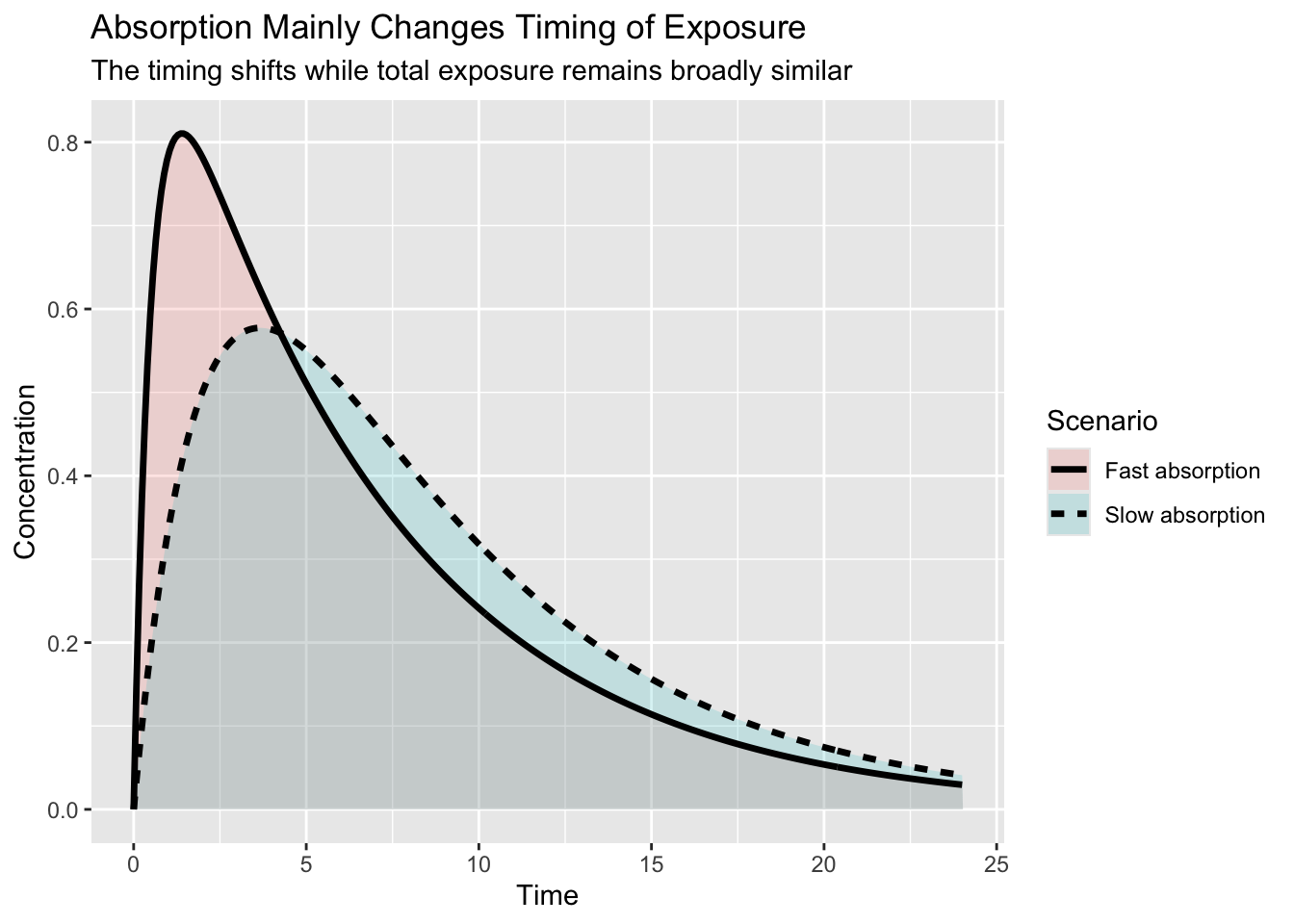
Now compare the same profiles with the area under the curve in mind.
AUC means:
Area Under the Concentration–Time Curve
AUC summarizes total exposure over time.
When dose, bioavailability, and clearance are unchanged, changing absorption rate mostly shifts when exposure occurs.
Notice:
- fast absorption → earlier and sharper appearance
- slow absorption → delayed and smoother appearance
- the total area is much more similar than the peak heights
That distinction matters because timing and amount are not the same concept.
Absorption rate primarily changes when exposure occurs, not necessarily how much exposure occurs overall.
Clinical Interpretation
Absorption rate helps explain:
- delayed onset of action
- early peak behavior
- formulation differences
- differences between oral and immediate-release dosing
It is especially important for:
- interpreting peak timing
- comparing formulations
- understanding onset of effect
Insight
A useful mental model:
Clearance controls how quickly drug leaves.
Absorption controls how quickly drug arrives.
Note
Always ask:
“Is concentration changing because drug is entering differently—or leaving differently?”
Strategies
- Inspect the rising portion of the profile carefully
- Compare timing as well as magnitude
- Separate absorption questions from elimination questions
- Interpret delayed peaks cautiously
Common Mistakes
- Assuming faster absorption means greater exposure
- Confusing delayed absorption with slower elimination
- Ignoring early sampling limitations
- Treating peak timing as purely elimination-driven
Practice Problems
- What does \(k_a\) represent?
- Does faster absorption guarantee greater exposure?
- Which part of the curve is most informative for absorption?
TipStep-by-Step Solutions
- The rate at which drug enters systemic circulation
- No—timing may change without increasing total exposure
- The rising and near-peak portion
Summary
Absorption rate determines:
- how quickly drug appears
- when concentration peaks
- how the early profile behaves
But absorption does not automatically determine total exposure.
Understanding absorption helps separate:
- arrival into the system
- removal from the system
TipQuick Tips
- \(k_a\) controls arrival
- Faster absorption ≠ more exposure
- Inspect the rising phase
- Timing matters
- Separate entry from removal