Understanding Variability in PK
Learn why variability exists, how to interpret it, and why it is central to pharmacometric decision-making.
Tip
What you’ll build today: a shift from thinking about “average behavior” to understanding variability as the driver of risk and decision-making.
Learning Objectives
By the end of this lesson, you will be able to:
- Define variability in pharmacokinetics
- Explain why variability matters more than the mean
- Distinguish key sources of variability
- Interpret variability in the context of real decisions
Key Ideas
Variability is a fundamental property of biological systems.
Even when:
- the same dose is given
- under the same conditions
patients will show different concentration–time profiles.
These differences arise from:
- physiology (e.g., organ function)
- metabolism (e.g., enzyme activity)
- body composition
- adherence and measurement variability
Insight: Variability is not noise — it is the primary signal that determines outcomes.
Warning
If you only look at the average profile, you can completely miss clinically important risks.
Worked Example: Same Dose, Different Outcomes
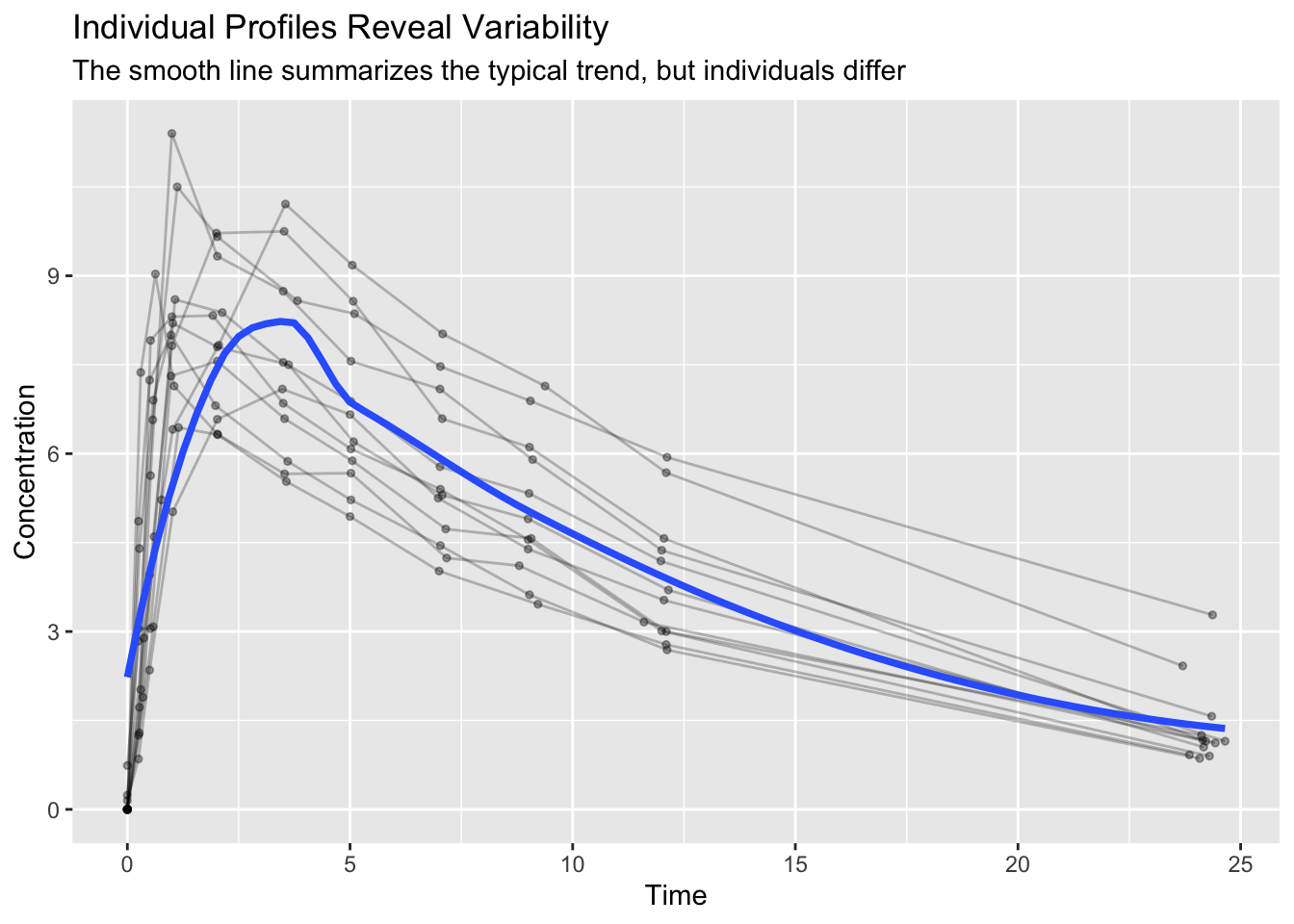
All subjects received similar dosing.
But:
- some have higher peaks
- some decline more slowly
- some have higher overall exposure
- some may fall closer to safety or efficacy boundaries
The average trend is useful, but it does not show the full risk.
Same dose can lead to different clinical consequences.
Expanding the Example: The Problem with the Mean
The mean can look acceptable while individual patients are spread widely around it.
A simple way to see this is to compare two populations with the same average exposure but different variability.
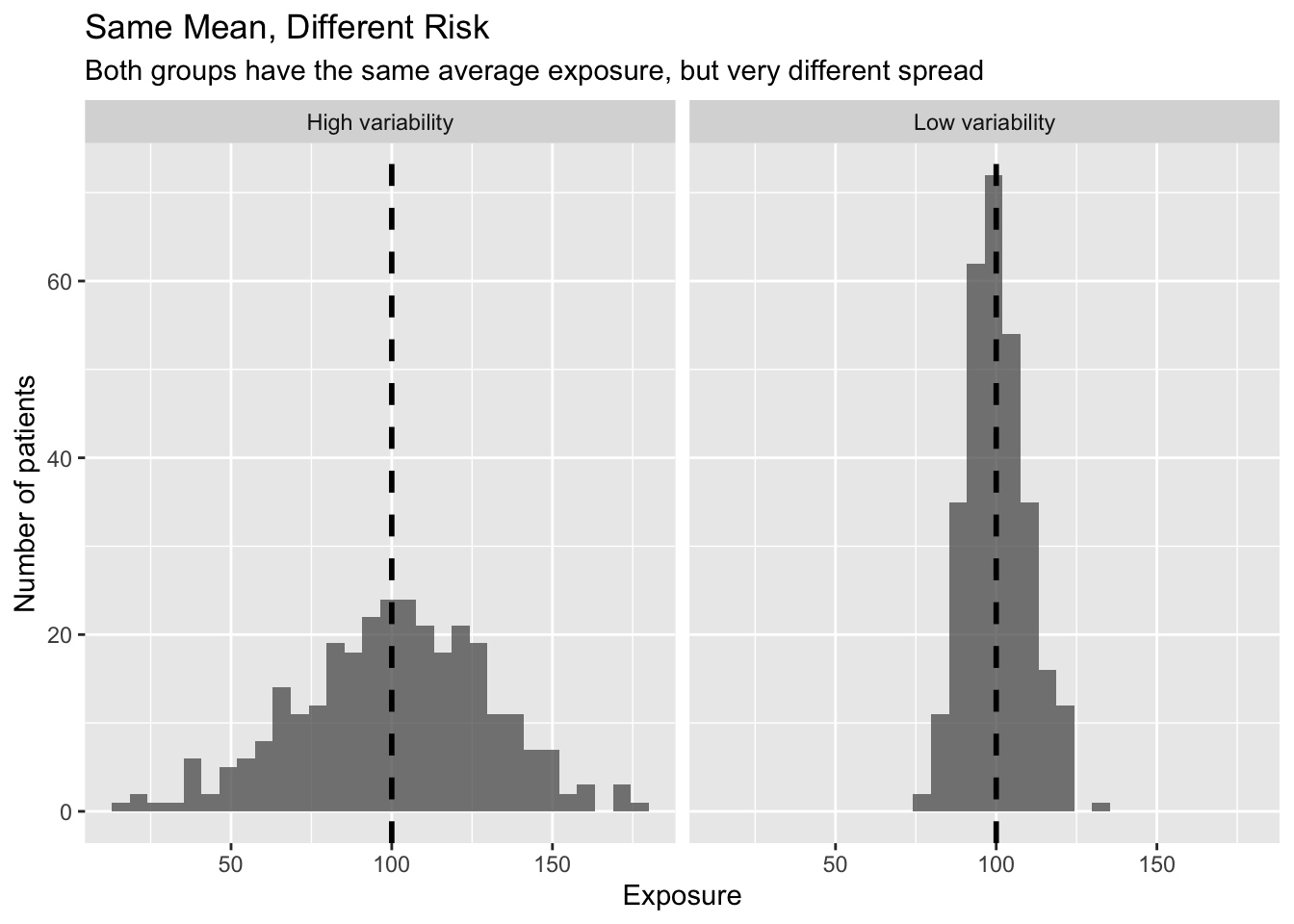
Both groups have the same mean exposure.
But the high-variability group has more patients at the extremes.
That matters because decisions often depend on questions like:
- How many patients are too low?
- How many patients are too high?
- How many remain in the target range?
This leads to a critical realization:
The “average patient” often does not exist in reality.
Insight
Pharmacometrics shifts the central question.
Instead of asking:
“What is the average exposure?”
You should ask:
“What fraction of patients are too high, too low, or within target?”
Note
Decisions are based on distributions, not averages.
Sources of Variability
Variability can come from multiple sources.
1. Between-Subject Variability (BSV)
- Differences across individuals
- e.g., clearance differs between patients
In pharmacometrics, this is often referred to as:
Interindividual Variability (IIV)
because it reflects differences between people rather than differences within the same person.
Examples:
- one patient clears drug faster
- another achieves higher exposure
- another reaches lower peak concentration
This creates differences in exposure across the population.
2. Within-Subject Variability
- Same individual behaves differently across measurements or occasions
- May reflect changes in physiology, behavior, or study conditions
A common pharmacometric example is:
Interoccasion Variability (IOV)
where the same individual shows different PK behavior across separate occasions (e.g., visits, treatment cycles, study periods).
This creates differences within the same patient over time.
3. Residual (Measurement) Error
- Variability remaining after accounting for known sources
- May reflect assay error, sampling variability, recording error, or model limitations
In pharmacometrics, this is often referred to as:
Residual Unexplained Variability (RUV)
because it represents the portion of variability that remains unexplained by the model.
RUV does not necessarily mean mistakes or bad data.
It reflects the reality that no model captures everything perfectly.
This creates differences between model predictions and observations.
Why Variability Matters for Decisions
Variability directly impacts:
- dose selection
- safety margins
- probability of achieving target exposure
Example:
- If variability is low → most patients near target
- If variability is high → many patients outside target
👉 Same mean, very different decision implications
Strategies
- Always inspect individual profiles
- Think in terms of ranges and percentiles
- Ask how variability impacts risk
- Consider extreme cases, not just the center
Common Mistakes
- Treating variability as noise
- Making decisions based on averages
- Ignoring high-risk subgroups
- Over-smoothing data during visualization
Practice Problems
- Why is variability more important than the mean in many decisions?
- What is the risk of relying only on an average profile?
- Give an example of how variability affects clinical outcomes
TipStep-by-Step Solutions
- Because variability determines how many patients fall outside safe or effective ranges
- It hides extremes and may not represent any real patient
- High variability in clearance can lead to some patients having toxic exposure while others are subtherapeutic
Summary
Variability is:
- unavoidable
- informative
- central to pharmacometrics
It determines:
- risk
- uncertainty
- decision outcomes
Understanding variability is the first step toward:
- population modeling
- covariate analysis
- individualized dosing
TipQuick Tips
- Variability is signal, not noise
- Mean ≠ reality
- Always think in distributions
- Focus on extremes, not just averages
- Variability drives decisions