library(tidyverse)
library(nlmixr2)
library(nlmixr2data)

data("theo_sd", package = "nlmixr2data")Predictions and Residuals
Extract and interpret predictions and residual quantities from the first population PK model.
Tip
Big picture: Predictions connect estimated parameters back to concentration-time behavior. Residuals quantify disagreement and introduce the idea of unexplained variation.
Learning Objectives
By the end of this lesson, you will be able to:
- Extract predictions from an
nlmixr2fit. - Distinguish
PREDandIPRED. - Understand residual concepts.
- Visualize observed versus predicted values.
- Recognize that residual quantities are generated automatically.
Key Ideas
- Predictions are generated from estimated parameters.
- Population and individual predictions differ.
- Residuals quantify disagreement.
- Residuals depend on the model assumptions.
Setup
Fit the model.
one_comp_model <- function(){

  ini({

    tka <- log(1)

    tcl <- log(3)

    tv <- log(30)

    eta.ka ~ 0.1
    eta.cl ~ 0.1
    eta.v ~ 0.1

    add.err <- 0.1

  })

  model({

    ka <- exp(tka + eta.ka)

    cl <- exp(tcl + eta.cl)

    v <- exp(tv + eta.v)

    linCmt() ~ add(add.err)

  })

}

fit <-
  nlmixr2(
    one_comp_model,
    theo_sd,
    est = "focei",
    control = list(
      print = 0
    )
  )

fit_tbl <- fit %>% as_tibble()
Why Predictions Matter
Estimation gives parameter estimates.
Predictions answer:
What concentrations does the model expect?
Residuals answer:
How different are observations from predictions?
Predictions connect:
Estimated Parameters

↓

Expected Concentrations
Residuals connect:
Observed

↓

Predicted

↓

Disagreement
Worked Example 1: Explore Prediction Variables
Inspect available variables.
names(fit_tbl) [1] "ID" "TIME" "DV" "PRED" "RES" "WRES" "IPRED"
[8] "IRES" "IWRES" "CPRED" "CRES" "CWRES" "eta.ka" "eta.cl"
[15] "eta.v" "depot" "central" "ka" "cl" "v" "tad"
[22] "dosenum"Common variables include:
| Variable | Meaning |
|---|---|
DV |
observed concentration |
PRED |
population prediction |
IPRED |
individual prediction |
These variables represent different views of model behavior.
Worked Example 2: Population Prediction
Visualize observed versus population prediction.
ggplot(
  fit_tbl,
  aes(PRED, DV)
) +
geom_point(
  alpha = 0.35
) +
geom_abline(
  slope = 1,
  intercept = 0,
  linetype = 2
) +
labs(
  title = "Observed vs Population Prediction",
  x = "PRED",
  y = "DV"
)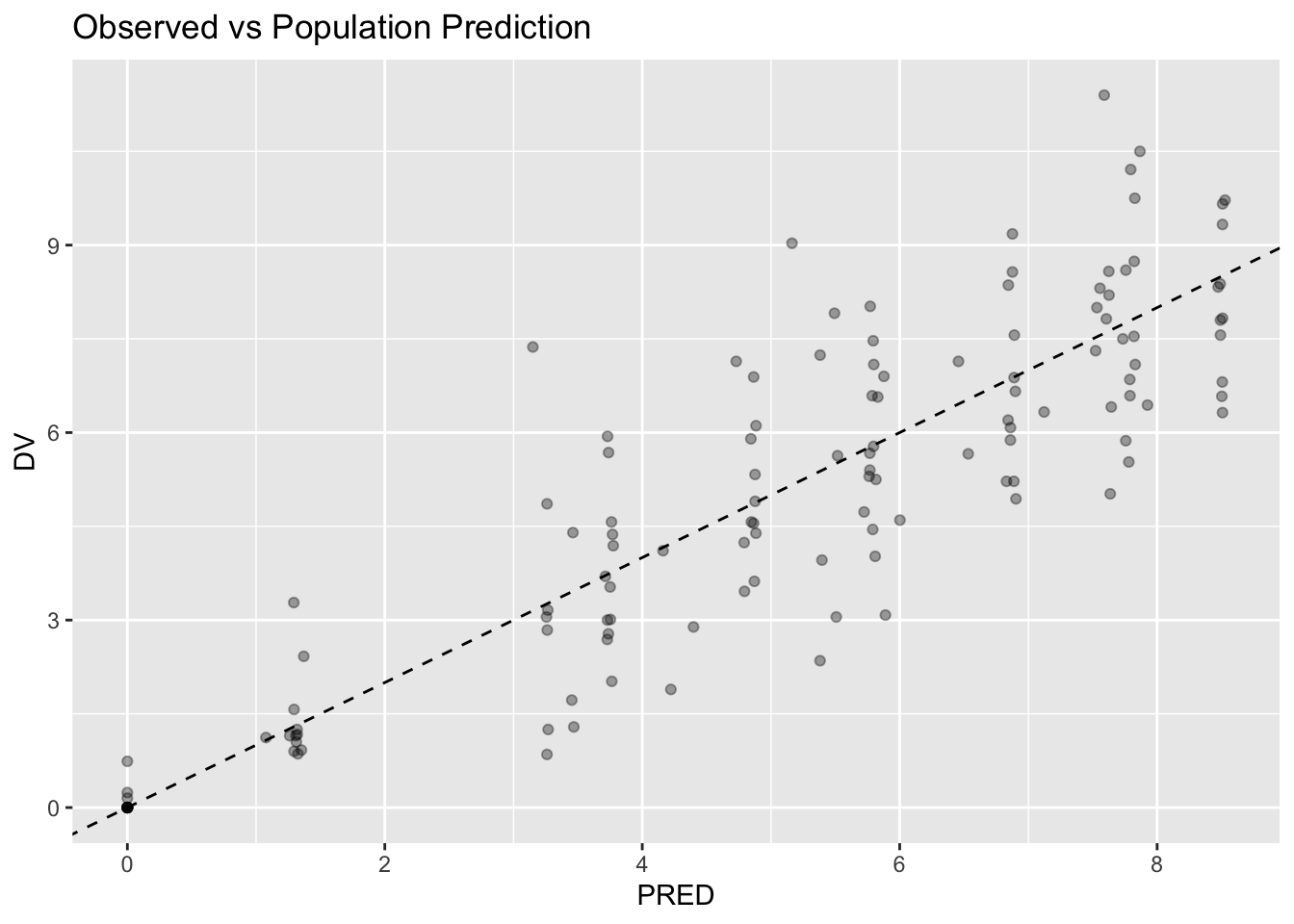
Interpretation:
Population predictions represent expected behavior for the typical subject.
Conceptually:
Typical Parameters

↓

Prediction
Worked Example 3: Individual Prediction
Visualize individual predictions.
ggplot(
  fit_tbl,
  aes(IPRED, DV)
) +
geom_point(
  alpha = 0.35
) +
geom_abline(
  slope = 1,
  intercept = 0,
  linetype = 2
) +
labs(
  title = "Observed vs Individual Prediction",
  x = "IPRED",
  y = "DV"
)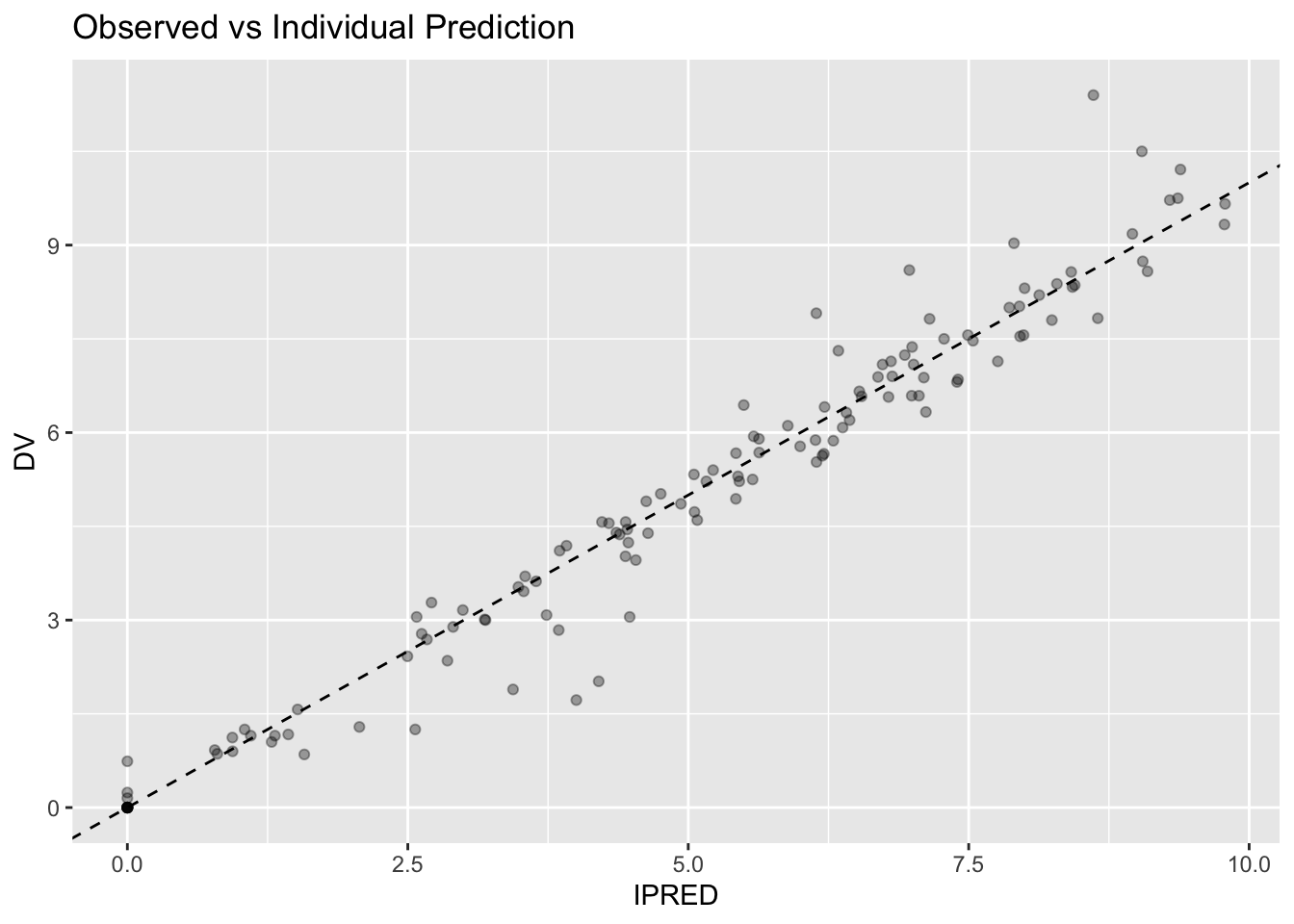
Interpretation:
Individual predictions include subject information.
Conceptually:
Typical Parameters

+

Individual Effects

↓

Prediction
Individual predictions often appear closer to observations.
Worked Example 4: Inspect Residual Quantities
Inspect residual quantities already stored in the fit object.
fit_tbl %>%
  select(
    ID,
    TIME,
    DV,
    PRED,
    IPRED,
    RES,
    IRES
  )
# A tibble: 132 × 7
ID TIME DV PRED IPRED RES IRES
<fct> <dbl> <dbl> <dbl> <dbl> <dbl> <dbl>
1 1 0 0.74 0 0 0.74 0.74
2 1 0.25 2.84 3.26 3.85 -0.422 -1.01
3 1 0.57 6.57 5.83 6.78 0.740 -0.215
4 1 1.12 10.5 7.87 9.04 2.63 1.46
5 1 2.02 9.66 8.51 9.79 1.15 -0.125
6 1 3.82 8.58 7.62 9.09 0.955 -0.514
7 1 5.1 8.36 6.84 8.45 1.52 -0.0853
8 1 7.03 7.47 5.79 7.54 1.68 -0.0682
9 1 9.05 6.89 4.87 6.69 2.02 0.198
10 1 12.1 5.94 3.73 5.58 2.21 0.356
# ℹ 122 more rowsInterpretation:
DV
Observed

PRED
Population Prediction

IPRED
Individual Prediction

RES
Observed − Population Prediction

IRES
Observed − Individual Prediction
Positive residual:
Observed > PredictedNegative residual:
Observed < PredictedThese quantities are generated automatically.
No manual residual calculation is needed.
Worked Example 5: Visualize Residual Behavior
Plot residuals.
ggplot(
  fit_tbl,
  aes(PRED, RES)
) +
geom_point(
  alpha = 0.35
) +
geom_hline(
  yintercept = 0,
  linetype = 2
) +
labs(
  title = "Residuals vs Population Prediction",
  x = "PRED",
  y = "RES"
)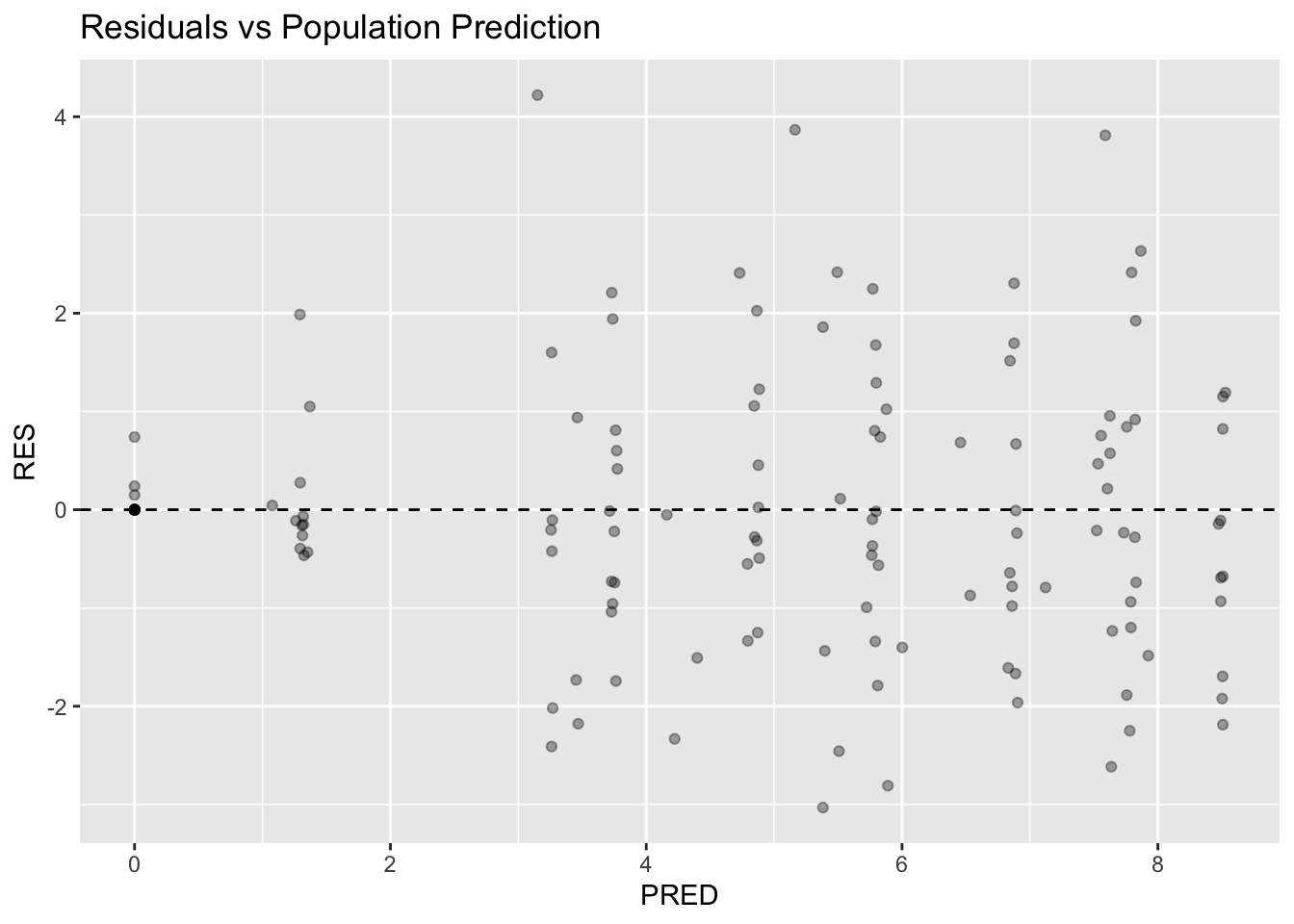
Interpretation:
For now, look for:
- approximate centering around zero
- similar spread
- absence of obvious patterns
Do not draw conclusions yet.
This plot introduces residual thinking.
Formal diagnostic interpretation comes later.
Residuals and Error
Residual quantities reflect disagreement.
That disagreement can arise from:
- measurement noise
- model simplification
- unexplained variability
Residual behavior depends on the assumed residual error model.
We revisit error models in the next module.
PRED vs IPRED
Conceptually:
PRED

Typical Subject

↓

Prediction
versus
IPRED

Typical Subject

+

Individual Effects

↓

Prediction
Both are useful.
They answer different questions.
Looking Ahead
We now have:
Model

↓

Fit

↓

Predictions

↓

Residuals
Next we ask:
Where does variability come from?Upcoming topics:
- random effects
- variability assumptions
- residual error models
- covariates
Strategies
- Compare predictions systematically.
- Inspect residual quantities.
- Delay conclusions.
Common Mistakes
- Expecting perfect prediction.
- Overinterpreting residuals.
- Ignoring variability assumptions.
Practice Problems
What does
PREDrepresent?What does
IPREDrepresent?Why are residuals useful?
Inspect:
fit_tbl %>%
  select(
    DV,
    PRED,
    IPRED,
    RES,
    IRES
  ) %>%
  head()
Choose one row and explain:
- what
RESmeans - whether the model overpredicted or underpredicted
- Create a residual plot.
ggplot(
  fit_tbl,
  aes(PRED, RES)
) +
geom_point(
  alpha = 0.35
) +
geom_hline(
  yintercept = 0,
  linetype = 2
)
Describe residual behavior.
Avoid formal diagnosis.
TipStep-by-Step Solutions
Problem 1
PRED represents predictions for the typical subject.
Problem 2
IPRED represents predictions including individual information.
Problem 3
Residuals quantify disagreement.
Conceptually:
Observed − PredictedProblem 4
Interpret:
Positive

↓

Observed > Predicted
Negative
↓
Observed < PredictedResidual quantities already exist.
Problem 5
Look for:
- centering
- spread
- obvious structure
Interpretation comes later.
Summary
- Predictions connect estimates to concentrations.
- PRED and IPRED answer different questions.
- Residual quantities are generated automatically.
- Residual thinking prepares us for variability.
TipQuick Tips
- PRED = typical
- IPRED = individual
- Residual ≠ failure
- Interpret before concluding