library(tidyverse)
library(nlmixr2)
library(nlmixr2data)What Is PK/PD Modeling?
Introduce pharmacodynamics and understand how exposure becomes response.
Tip
Big picture: PK models describe exposure. PK/PD models explain how exposure becomes response.
Learning Objectives
By the end of this lesson, you will be able to:
- distinguish pharmacokinetics and pharmacodynamics
- explain exposure–response relationships
- understand the idea of multiple endpoints
- recognize direct and delayed responses
- explain why PK alone is often insufficient
Key Ideas
- PK describes concentration
- PD describes response
- concentration is not always the final outcome
- response may occur immediately or with delay
Why Extend PK Models?
Until now, we focused on questions such as:
Dose → ConcentrationBut real decisions often ask:
- Did the drug work?
- Was toxicity observed?
- Did the biomarker change?
Those questions require pharmacodynamics.
PK/PD extends the workflow:
Dose

↓

Concentration

↓

Response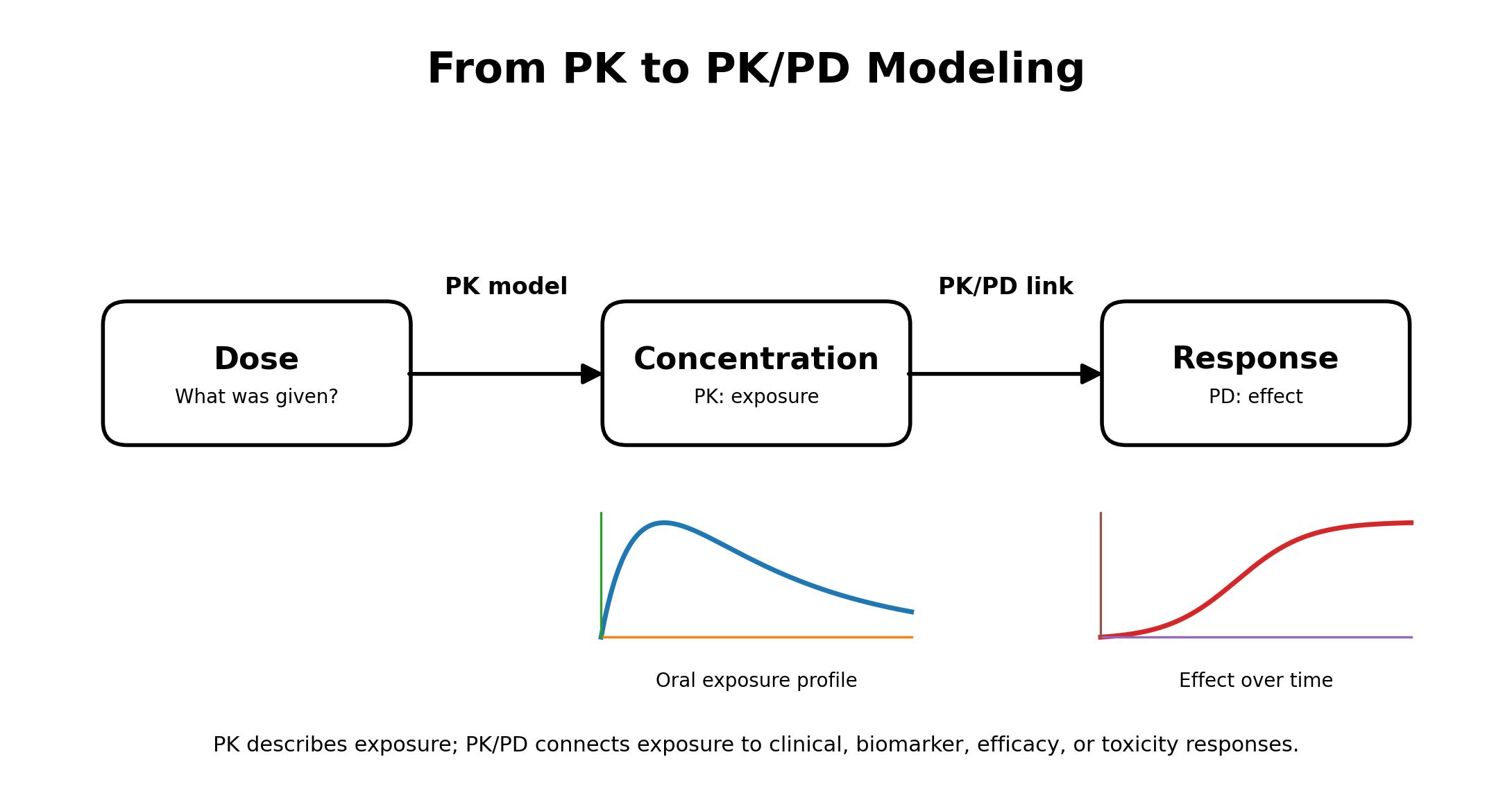
PK versus PD
Compare the two concepts.
PK → What concentration occurred?

PD → What effect occurred?
Examples:
| Question | Domain |
|---|---|
| What exposure occurred? | PK |
| Did blood pressure decrease? | PD |
| Did INR increase? | PD |
| Did concentration change? | PK |
Interpretation:
PK describes:
Drug → BodyPD describes:
Body → ResponseWorked Example 1: Exposure Does Not Equal Response
Suppose two patients have the same exposure.
Same Concentration → Different ResponsePossible reasons:
- biological differences
- sensitivity differences
- delayed response
- variability
This motivates PK/PD modeling.
Worked Example 2: One Subject Can Produce Multiple Endpoints
Earlier we modeled one endpoint.
Conceptually:
Subject → ConcentrationPK/PD introduces:
Subject → PK Endpoint + PD EndpointExamples:
| Endpoint | Example |
|---|---|
| PK | concentration |
| PD | biomarker |
| PD | efficacy |
| PD | toxicity |
This idea is called:
Multiple EndpointsMultiple outcomes may come from the same subject.
Worked Example 3: Warfarin Example
Warfarin provides a useful PK/PD example.
INR is a clinical measure related to blood clotting. For warfarin, INR is often used as a response endpoint.
Conceptually:
Dose

↓

Warfarin Concentration

↓

INR Response
Question:
Does concentration immediately determine INR?Not necessarily.
Response may appear later.
This introduces delayed effects.
Worked Example 4: Immediate and Delayed Response
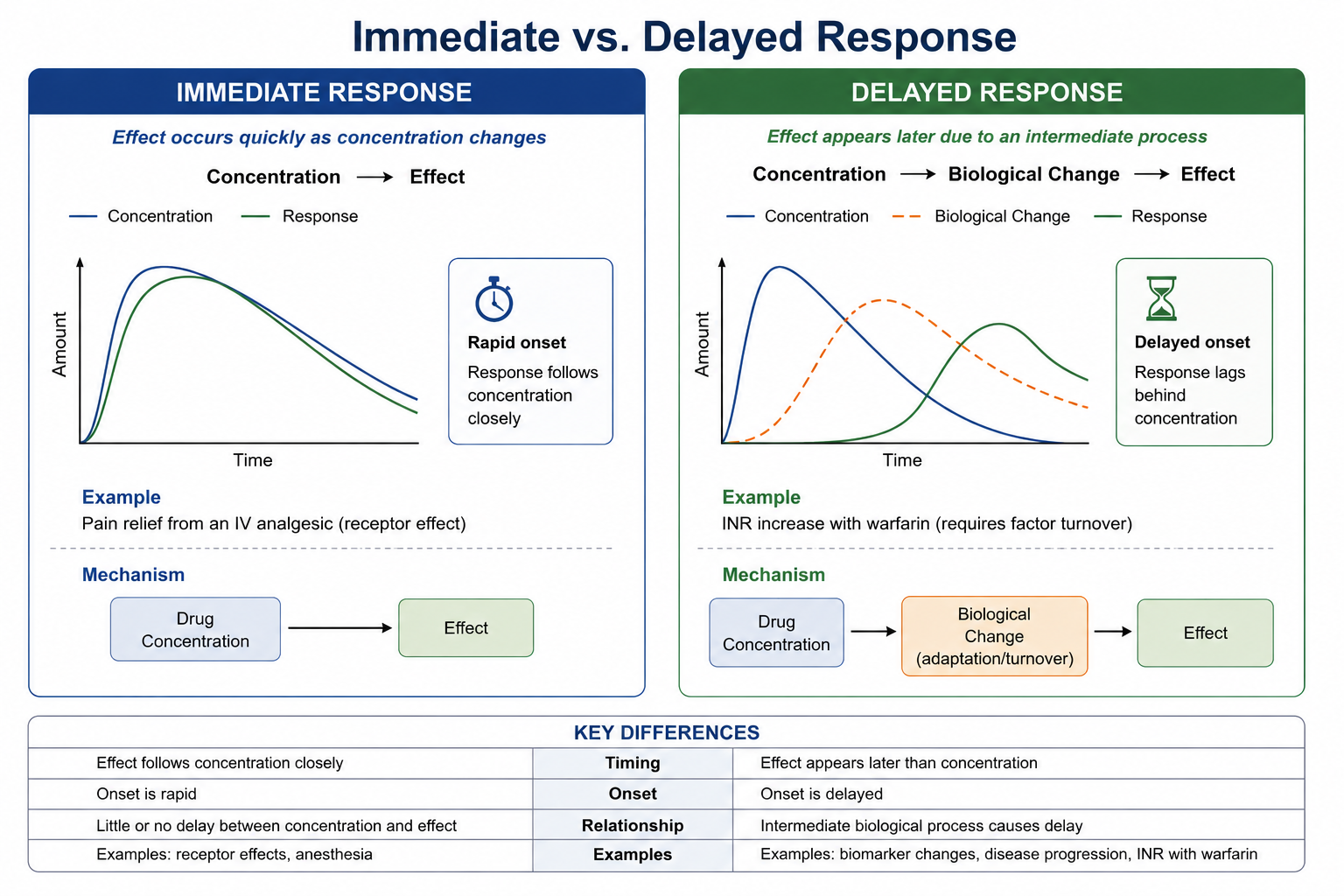
Some responses occur quickly.
Conceptually:
Concentration → EffectOther responses appear gradually.
Conceptually:
Concentration → Biological Change → EffectExamples:
| Pattern | Example |
|---|---|
| immediate | direct receptor effect |
| delayed | biomarker turnover |
Delayed behavior motivates later PK/PD models.
Worked Example 5: What Changes in PK/PD?
Population PK focused on:
Estimate ExposurePK/PD adds:
Estimate Exposure

↓

Explain Response
Questions become:
- How much response occurs?
- When does response occur?
- Why do subjects differ?
Software Used
We continue using:
No fitting yet.
This lesson focuses on concepts.
Looking Ahead
Next lesson introduces models that connect:
Concentration → ResponseWe begin with:
- direct effect
- saturation
- Emax relationships
Strategies
- separate concentration and response
- identify endpoints
- think mechanistically
Common Mistakes
- treating PK as the final goal
- ignoring delayed effects
- assuming one endpoint
Practice Problems
What is the difference between PK and PD?
Why is concentration not always sufficient?
Give one PK endpoint and one PD endpoint.
Why can two subjects show different responses?
What does multiple endpoints mean?
TipStep-by-Step Solutions
Problem 1
PK → concentration

PD → response
Problem 2
Response depends on biology.
Problem 3
Example:
PK → concentration

PD → INR
Problem 4
Response variability exists.
Problem 5
One subject may contribute more than one outcome.
Summary
- PK describes exposure
- PD describes response
- concentration is not always sufficient
- PK/PD introduces multiple endpoints
- response may be delayed
TipQuick Tips
- PK ≠ PD
- Exposure ≠ response
- Multiple endpoints matter
- Delay matters